

An element's name, atomic weight, and oxidation state(s) will appear when you scroll over an element's symbol. Oxidation states in blue refer to standards made by Inorganic Ventures. Those in italics are most common. A red X indicates the element is not commercially available for analytical work.
Click on an element to get Analytical ICP data
- Solid (g/cm3, 20°C)
- Liquid (g/mL, 20°C)
- Gas (g/L, 0°C, 1atm)
- Artificially created
1
IA
IA
1
1
H
X
Hydrogen
1.008
+1, 0, -1
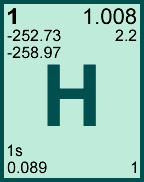
Hydrogen
1.008
+1, 0, -1
18
VIIIA
VIIIA
2
He
X
Helium
4.003
0
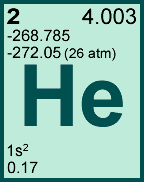
Helium
4.003
0
2
3
Li
Lithium
6.941
+1
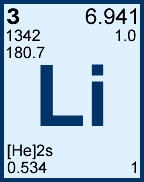
Lithium
Group 1, Period 2
6.941
(6)
(assumed, not certain)
Li+(aq) (large effective radius due to hydration sphere)
+1
Storage & Handling: Keep tightly sealed when not in use. Store and use at 20 ± 4°C. Do not pipet from container. Do not return portions removed for pipetting to container.
Chemical Compatibility: Soluble in HCl, HNO3, H2SO4, and HF aqueous matrices. Stable with all metals and inorganic anions.
Stability: 2-100 ppb levels stable for months in 1% HNO3 / LDPE container. 1-10,000 ppm solutions chemically stable for years in 1-5% HNO3 / LDPE container.
Li Containing Samples (Preparation & Solution): Metal (dissolves very rapidly in water); Ores (sodium carbonate fusion in Pt0 followed by HCl dissolution - blank levels of Li in sodium carbonate critical); Organic Matrices (sulfuric / peroxide digestion or nitric / sulfuric / perchloric acid decomposition).
Atomic Spectroscopic Information:(red text indicates severe at ~ concs.)
| Technique / Line | Estimated D.L.* | Order | Type | Interferences |
|---|---|---|---|---|
| ICP-OES 670.784 nm | 0.002/.00002 µg/mL | 1 | atom | ** |
| ICP-OES 460.286 nm | 0.9/.04 µg/mL | 1 | atom | Zr, Th |
| ICP-OES 323.261 nm | 1.1/.05 µg/mL | 1 | atom | Sb, Th, Ni |
| ICP-MS 7 amu | 10 ppt | n/a | M+ |
*ICP-OES D.L.'s are given as radial / axial view
**2nd order radiation from R.E.s on some optical designs
2
IIA
IIA
4
Be
Beryllium
9.012
+2
Beryllium
Group 2, Period 2
9.012
4
Be+(H2O)4+2
+2
Storage & Handling: Keep tightly sealed when not in use. Store and use at 20 ± 4°C. Do not pipet from container. Do not return portions removed for pipetting to container.
Chemical Compatibility: Soluble in HCl, HNO3, H2SO4 and HF aqueous matrices. Stable with all metals and inorganic anions.
Stability: 2-100 ppb levels stable for months in 1% HNO3 / LDPE container. 1-10,000 ppm solutions chemically stable for years in 5-10% HNO3 / LDPE container.
Be Containing Samples (Preparation & Solution): Metal (is best dissolved in diluted H2SO4); BeO (boiling nitric, hydrochloric, or sulfuric acids or KHSO4 fusion); Ores (H2SO4/HF digestion or carbonate fusion in Pt0); Organic Matrices (sulfuric / peroxide digestion or nitric / sulfuric / perchloric acid decomposition, or dry ash and dissolution according to the BeO procedure above).
Atomic Spectroscopic Information:(red text indicates severe at ~ concs.)
| Technique / Line | Estimated D.L.* | Order | Type | Interferences |
|---|---|---|---|---|
| ICP-OES 313.042 nm | 0.0003/.00009 µg/mL | 1 | ion | V, Ce, U |
| ICP-OES 234.861 nm | 0.0003/.00016 µg/mL | 1 | atom | Fe, Ta, Mo |
| ICP-OES 313.107 nm | 0.0007/.0005 µg/mL | 1 | ion | Ce, Th, Tm |
| ICP-MS 9 amu | 4 ppt | n/a | M+ |
*ICP-OES D.L.'s are given as radial / axial view
13
IIIA
IIIA
5
B
Boron
10.811
+3
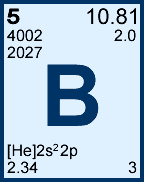
Boron
Group 13, Period 2
10.811
(4)
B(OH)3 and B(OH)4-1
+3
Storage & Handling: Keep tightly sealed when not in use. Store and use at 20 ± 4°C. Do not pipet from container. Do not return portions removed for pipetting to container.
Chemical Compatibility: Moderately soluble in HCl, HNO3, H2SO4 and HF aqueous matrices and very soluble in NH4OH. Stable with all metals and inorganic anions at low to moderate ppm levels.
Stability: 2-100 ppb levels stable for months in 1% HNO3 / LDPE container. 1-1,000 ppm solutions chemically stable for years in 1% HNO3 / LDPE container. 1000-10,000 ppm stable for years in dilute NH4OH / LDPE container.
B Containing Samples (Preparation & Solution): Metal (crystalline form is scarcely attacked by acids or alkaline solutions; amorphous form is soluble in conc. HNO3 or H2SO4); B(OH)3 (water soluble); Ores (avoid acid digestions and use caustic fusions in Pt0); Organic Matrices (dry ash mixed with Na2CO3 in Pt0at 450°C then increase heat to 1000°C to fuse; or perform a Na2O2 fusion in a Ni0 crucible / Parr bomb).
Atomic Spectroscopic Information:(red text indicates severe at ~ concs.)
| Technique / Line | Estimated D.L.* | Order | Type | Interferences |
| ICP-OES 249.773 nm | 0.003/.001 µg/mL | 1 | atom | W, Ce, Co, Th, Ta, Mn, Mo, Fe |
| ICP-OES 249.678 nm | 0.004/.003 µg/mL | 1 | atom | Os, W, Co, Cr, Hf |
| ICP-OES 208.959 nm | 0.007/.0005 µg/mL | 1 | atom | Mo |
| ICP-MS 11 amu | 700 ppt | n/a | M+ | |
| *ICP-OES D.L.'s are given as radial / axial view | ||||
14
IVA
IVA
6
C
Carbon
12.011
+4, +2, -4
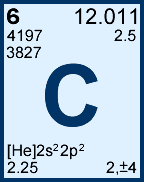
Carbon
Group 14, Period 2
12.011
(4)
(Carbon standard is made using Tartaric Acid)
+4, +2, -4
Storage & Handling: Keep tightly sealed when not in use. Store and use at 20 ± 4°C. Do not pipet from container. Do not return portions removed for pipetting to container.
Chemical Compatibility: Moderately soluble in HCl, HNO3, H2SO4, and HF aqueous matrices and very soluble in NH4OH. Stable with all metals and inorganic anions at low to moderate ppm levels. Do not dilute or store Carbon standards using plastic containers or similar devices.
Stability: 2-100 ppb level stability unknown. 1000-10,000 ppm level stable for years in dilute acidic media in a glass container.
C Containing Samples (Preparation & Solution): elemental amorphic or graphitic carbon (Oxidative closed vessel fusion such as a Na2O2 fusion in a sealed Ni0 crucible / Parr bomb); H2CO3 (water soluble); Organic Compounds (water solubility is best if possible, or perform a Na2O2 fusion in a sealed Ni0crucible / Parr bomb).
Atomic Spectroscopic Information:(red text indicates severe at ~ concs.)
| Technique / Line | Estimated D.L.* | Order | Type | Interferences |
| ICP-OES 193.091 nm | 0.05/.005 µg/mL | 1 | atom | In, Ru, Mn |
| ICP-OES 247.856 nm | 0.2/.02 µg/mL | 1 | atom | Nb, V, Ti |
| ICP-MS 12 amu | (uncertain) | n/a | M+ | |
| *ICP-OES D.L.'s are given as radial / axial view | ||||
15
VA
VA
7
N
Nitrogen
14.007
+5, +4, +3, +2, -1, -2, -3
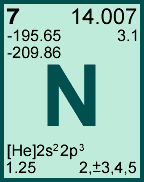
Nitrogen
14.007
+5, +4, +3, +2, -1, -2, -3
16
VIA
VIA
8
O
Oxygen
15.999
+2, +1, 0, -1, -2
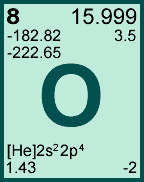
Oxygen
15.999
+2, +1, 0, -1, -2
17
VIIA
VIIA
9
F
Fluorine
18.998
-1
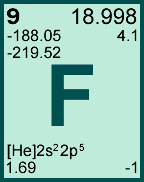
Fluorine
18.998
-1
10
Ne
X
Neon
20.179
0
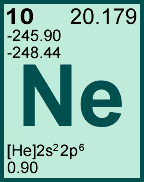
Neon
20.179
0
3
11
Na
Sodium
22.98977
+1
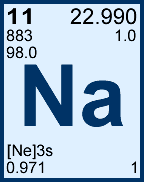
Sodium
Group 1, Period 3
22.98977
(6)
(assumed, not certain)
Na+(aq) (largely ionic in nature)
+1
Storage & Handling: Keep tightly sealed when not in use. Store and use at 20 ± 4°C. Do not pipet from container. Do not return portions removed for pipetting to container.
Chemical Compatibility: Soluble in HCl, HNO3, H2SO4 and HF aqueous matrices. Stable with all metals and inorganic anions.
Stability: 2-100 ppb levels stable for months in 1% HNO3 / LDPE container. 1-10,000 ppm solutions chemically stable for years in 1-5% HNO3 / LDPE container.
Na Containing Samples (Preparation & Solution): Metal (dissolves very rapidly in water); Ores (lithium carbonate fusion in graphite crucible followed by HCl dissolution - blank levels of Na in lithium carbonate critical); Organic Matrices (sulfuric / peroxide digestion or nitric / sulfuric / perchloric acid decomposition).
Atomic Spectroscopic Information:(red text indicates severe at ~ concs.)
| Technique / Line | Estimated D.L.* | Order | Type | Interferences |
| ICP-OES 589.595 nm | 0.07/.00009 µg/mL | 1 | atom | ** |
| ICP-OES 588.995 nm | 0.03/.006 µg/mL | 1 | atom | ** |
| ICP-OES 330.237 nm | 2.0/.09 µg/mL | 1 | atom | Pd, Zn |
| ICP-MS 23 amu | 310 ppt | n/a | M+ | 46Ti+2, 46Ca+2 |
| *ICP-OES D.L.'s are given as radial / axial view **2nd order radiation from R.E.s on some optical designs | ||||
12
Mg
Magnesium
24.305
+2
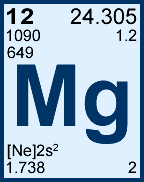
Magnesium
Group 2, Period 3
24.305
(6)
Mg(H2O)6+2
+2
Storage & Handling: Keep tightly sealed when not in use. Store and use at 20 ± 4°C. Do not pipet from container. Do not return portions removed for pipetting to container.
Chemical Compatibility: Soluble in HCl, HNO3 and H2SO4. Avoid HF, H3PO4, and neutral to basic media. Stable with most metals and inorganic anions forming insoluble silicates, carbonates, hydroxides, oxides, and tungstates in neutral and slightly acidic media.
Stability: 2-100 ppb levels stable for months in 1% HNO3 / LDPE container. 1-10,000 ppm solutions chemically stable for years in 1-10% HNO3 / LDPE container.
Mg Containing Samples (Preparation & Solution): Metal (best dissolved in diluted HNO3); Oxide (readily soluble in above compatible aqueous acidic solutions); Ores (carbonate fusion in Pt0 followed by HCl dissolution); Organic Matrices (sulfuric / peroxide digestion or nitric / sulfuric / perchloric acid decomposition, or dry ash and dissolution in dilute HCl. Do not heat when dissolving to avoid precipitation of SiO2).
Atomic Spectroscopic Information:(red text indicates severe at ~ concs.)
| Technique / Line | Estimated D.L.* | Order | Type | Interferences |
| ICP-OES 279.553 nm | 0.0002/.00003 µg/mL | 1 | ion | Th |
| ICP-OES 280.270 nm | 0.0003/.00005 µg/mL | 1 | ion | U, V |
| ICP-OES 285.213 nm | 0.002/.00003 µg/mL | 1 | atom | U, Hf, Cr, Zr |
| ICP-MS 24 amu | 42 ppt | n/a | M+ | 7Li17O, 48Ti+2, 48Ca+2 |
| *ICP-OES D.L.'s are given as radial / axial view | ||||
13
Al
Aluminum
26.98154
+3
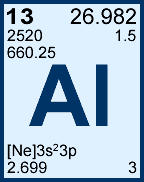
Aluminum
Group 13, Period 3
26.98154
(6)
Al(H2O)6+3
+3
Storage & Handling: Keep tightly sealed when not in use. Store and use at 20 ± 4°C. Do not pipet from container. Do not return portions removed for pipetting to container.
Chemical Compatibility: Soluble in HCl, HNO3, HF and H2SO4. Avoid neutral media. Soluble in strongly basic NaOH forming the Al(OH)4(H2O)21- species. Stable with most metals and inorganic anions. The phosphate is insoluble in water and only slightly soluble in acid.
Stability: 2-100 ppb levels stable for months in 1% HNO3 / LDPE container. 1-10,000 ppm solutions chemically stable for years in 2-5% HNO3 / LDPE container.
Al Containing Samples (Preparation & Solution): Metal (is best dissolved in HCl/ HNO3); α - Al2O3(Na2CO3 fusion in Pt0); γ - Al2O3 (soluble in acids such as HCl); Ores (carbonate fusion in Pt0 followed by HCl dissolution); Organic Matrices (sulfuric / peroxide digestion or nitric / sulfuric / perchloric acid decomposition, or dry ash and dissolution in dilute HCl.
Atomic Spectroscopic Information:(red text indicates severe at ~ concs.)
| Technique / Line | Estimated D.L.* | Order | Type | Interferences |
| ICP-OES 394.401 nm | 0.05/.006 µg/mL | 1 | atom | U, Ce |
| ICP-OES 396.152 nm | 0.03/.006 µg/mL | 1 | atom | Mo, Zr, Ce |
| ICP-OES 167.078 nm | 0.1/.009 µg/mL | 1 | ion | Fe |
| ICP-MS 27 amu | 30 ppt | n/a | M+ | 12C15N, 13C14N, 1H12C14N, 11B16O, 54Cr2+, 54Fe2+ |
| *ICP-OES D.L.'s are given as radial / axial view | ||||
14
Si
Silicon
28.0855
+4, +2
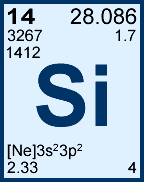
Silicon
Group 14, Period 3
28.0855
(6)
Si(OH)x(F)y2-
+4, +2
Storage & Handling: Keep tightly sealed when not in use. Store and use at 20 ± 4°C. Do not pipet from container. Do not return portions removed for pipetting to container.
Chemical Compatibility: Soluble in HCl, HF, H3PO4, H2SO4, and HNO3 as the Si(OH)x(F)y2-. Avoid neutral to basic media. Unstable at ppm levels with metals that would pull F- away (i.e. - do not mix with Alkaline or Rare Earths, or high levels of transition elements unless they are fluorinated). Stable with most inorganic anions with a tendency to hydrolyze forming silicic acid (silicic acid is soluble up to ~ 100 ppm in water) in all dilute acids except HF.
Stability: 2-100 ppb levels - stability unknown - (alone or mixed with all other metals) as the Si(OH)x(F)y2-. 1-10,000 ppm single element solutions as the Si(OH)x(F)y2- chemically stable for years in 2-5% HNO3 / trace HF in a LDPE container.
Si Containing Samples (Preparation & Solution): Metal (soluble in 1:1:1 H2O / HF / HNO3); Oxide - SiO2, amorphic (dissolve by heating in 1:1:1 H2O / HF / HNO3); Oxide-quartz (fuse in Pt0 with Na2CO3); Geological Samples (fuse in Pt0 with Na2CO3 followed by HCl solution of the fuseate); Organic Matrices containing silicates and non volatile silicon compounds (dry ash at 450°C in Pt0 and dissolve by gently warming with 1:1:1 H2O / HF / H2SO4 or fuse / ash with Na2CO3 and dissolve fuseate with HCl / H2O); Silicone Oils - dimethyl silicones depolymerize to form volatile monomer units when heated (measure directly in alcoholic KOH / xylene mixture where sample is treated first with the KOH at 60 - 100°C to "unzip" the Si-O-Si polymeric structure or digest with conc. H2SO4 / H2O2 followed by cooling and dissolution of the dehydrated silica with HF). Note that the direct analysis of silicone oils in an organic solvent will result in false high results due to high vapor pressure of volatile monomer units such as hexamethylcyclotrisiloxane. The KOH forms the K2+Si(CH3)2O=NaCl, which is not volatile at room temperature.
Atomic Spectroscopic Information:(red text indicates severe at ~ concs.)
| Technique / Line | Estimated D.L.* | Order | Type | Interferences |
| ICP-OES 251.611 nm | 0.012/.003 µg/mL | 1 | ion | Ta, U, Zn, Th |
| ICP-OES 212.412 nm | 0.02/.01 µg/mL | 1 | ion | Hf, Os, Mo, Ta |
| ICP-OES 288.158 nm | 0.03/.004 µg/mL | 1 | ion | Ta, Ce, Cr, Cd, Th |
| ICP-MS 28 amu | 4000 - 8000 ppt | n/a | M+ | 14N2, 12C16O |
| *ICP-OES D.L.'s are given as radial / axial view | ||||
15
P
Phosphorus
30.97376
+5, +3, +2, +1, -2, -3
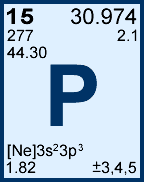
Phosphorus
Group 15, Period 3
30.97376
(6)
OP(OH)2(O)1-
+5, +3, +2, +1, -2, -3
Storage & Handling: Keep tightly sealed when not in use. Store and use at 20 ± 4°C. Do not pipet from container. Do not return portions removed for pipetting to container.
Chemical Compatibility: Soluble in HCl, HNO3, H2SO4, HF, water, and NH4OH. Stable with all metals and inorganic anions at low to moderate ppm levels under acidic conditions; precipitates with several metals occur in neutral media at higher concentrations.
Stability: 2-100 ppb levels - stability unknown - in 1% HNO3 / LDPE container. 1-10,000 ppm solutions chemically stable for years in 0-1% HNO3 / LDPE container.
P Containing Samples (Preparation & Solution): Metal (never found free in nature); Oxides (water soluble); Ores (naturally occurring only as the phosphate, except for a few rare minerals found in meteorites - Na2CO3 fusion in Pt0); Organic Matrices (dry ash mixed with Na2CO3 in Pt0 at 450°C then increase heat to 1000°C to fuse; or, perform a H2SO4 / H2O2 acid digestion).
Atomic Spectroscopic Information:(red text indicates severe at ~ concs.)
| Technique / Line | Estimated D.L.* | Order | Type | Interferences |
| ICP-OES 178.287 nm | 0.03/.002 µg/mL | 1 | atom | I |
| ICP-OES 177.495 nm | 0.01/.005 µg/mL | 1 | atom | Cu, Hf |
| ICP-OES 213.618 nm | 0.08/.03 µg/mL | 1 | atom | Cu, Mo |
| ICP-MS 31 amu | 6000+ ppt | n/a | M+ | 15N21H, 15N16O, 14N17O, 13C18O, 12C18O1H, 62Ni2+ |
16
S
Sulfur
32.066
+6, +5, +4, +3, +2, +1, -1, -2
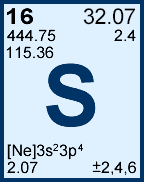
Sulfur
Group 16, Period 3
32.066
(6)
(O)2S(OH)2
+6, +5, +4, +3, +2, +1, -1, -2
Storage & Handling: Keep tightly sealed when not in use. Store and use at 20 ± 4°C. Do not pipet from container. Do not return portions removed for pipetting to container.
Chemical Compatibility: Soluble in HCl, HNO3, H3PO4, and HF aqueous matrices, water, and NH4OH. Stable with all metals and inorganic anions at low to moderate ppm levels under acidic conditions, except Ba, Pb, Ca, and to a lesser extent Sr.
Stability: 2-100 ppb levels - stability unknown - in 1% HNO3 / LDPE container. 1-10,000 ppm solutions chemically stable for years in LDPE container.
S Containing Samples (Preparation & Solution): We most often get questions about the determination of S in rocks, silicates and insoluble sulfates (the finely powered sample is fused in a Pt0 crucible with 6 times its weight of Na2CO3 + 0.5 grams KNO3. The fuseate is extracted with water. Any BaSO4 present in the sample is transposed by the carbonate fusion to the BaCO3, which is left behind in the water-insoluble residue. If PbSO4 is present, the fuseate should be boiled with a sodium carbonate saturated with CO2 solution for 1 hour or more. The PbSO4 will be transposed to the water insoluble carbonate which can be filtered off. Boiling the fuseate with a saturated carbonate solution is good insurance for samples containing Ba, Pb, Sr, and Ca. The Ba, Pb, Sr, and Ca free filtrate can be acidified and measured by ICP).
Atomic Spectroscopic Information:(red text indicates severe at ~ concs.)
| Technique / Line | Estimated D.L.* | Order | Type | Interferences |
| ICP-OES 166.669 nm | 0.2/.19 µg/mL | 1 | atom | Si, B |
| ICP-OES 182.034 nm | 0.3/.024 µg/mL | 1 | atom | |
| ICP-OES 143.328 nm | 0.4/.035 µg/mL | 1 | atom | |
| ICP-MS 32 amu | 30,000 ppt | n/a | M+ | 16O2, 14N18O, 15N17O, 14N17O1H, 15N16O1H |
| *ICP-OES D.L.'s are given as radial / axial view | ||||
17
Cl
Chlorine
35.453
+7, +6, +5, +4, +3, +1, -1, -2
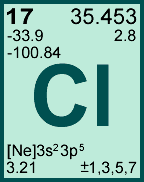
Chlorine
35.453
+7, +6, +5, +4, +3, +1, -1, -2
18
Ar
X
Argon
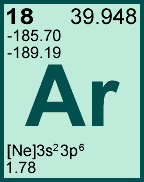
39.948
0
Argon
39.948
0
Period
4
4
19
K
Potassium
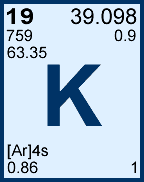
39.0983
+1
Potassium
Group 1, Period 4
39.0983
(6)
(assumed, not certain)
K+(aq)
+1
Storage & Handling: Keep tightly sealed when not in use. Store and use at 20 ± 4°C. Do not pipet from container. Do not return portions removed for pipetting to container.
Chemical Compatibility: Soluble in HCl, HNO3, H2SO4, and HF aqueous matrices. Avoid use of HClO4due to insolubility of the perchlorate. Stable with all metals and inorganic anions except ClO4-.
Stability: 2-100 ppb levels stable for months in 1% HNO3 / LDPE container. 1-10,000 ppm solutions chemically stable for years in 1-5% HNO3 / LDPE container.
K Containing Samples (Preparation & Solution): Metal (dissolves very rapidly in water); Ores (sodium carbonate fusion in Pt0 followed by HCl dissolution - blank levels of K in sodium carbonate critical); Organic Matrices (sulfuric / peroxide digestion).
Atomic Spectroscopic Information:(red text indicates severe at ~ concs.)
| Technique / Line | Estimated D.L.* | Order | Type | Interferences |
| ICP-OES 766.490 nm | 0.4/.001 µg/mL | 1 | atom | ** |
| ICP-OES 771.531 nm | 1.0/.03 µg/mL | 1 | atom | ** |
| ICP-OES 404.721 nm | 1.1/.05 µg/mL | 1 | atom | U, Ce |
| ICP-MS 39 amu | 10 ppt | n/a | M+ | 38Ar1H, 23Na16O, 78Se+2 |
| *ICP-OES D.L.'s are given as radial / axial view **2nd order radiation from R.E.s on some optical designs | ||||
20
Ca
Calcium
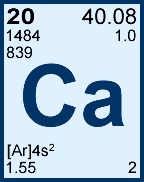
40.078
+2
Calcium
Group 2, Period 4
40.078
(6)
Ca(H2O)6+2
+2
Storage & Handling: Keep tightly sealed when not in use. Store and use at 20 ± 4°C. Do not pipet from container. Do not return portions removed for pipetting to container.
Chemical Compatibility: Soluble in HCl and HNO3. Avoid H2SO4 HF, H3PO4 and neutral to basic media. Stable with most metals and inorganic anions forming insoluble silicate, carbonate, hydroxide, oxide, fluoride, sulfate, oxalate, chromate, arsenate, and tungstate in neutral aqueous media.
Stability: 2-100 ppb levels stable for months in 1% HNO3 / LDPE container. 1-10,000 ppm solutions chemically stable for years in 1-10% HNO3 / LDPE container.
Ca Containing Samples (Preparation & Solution): Metal (best dissolved in diluted HNO3); Ores (carbonate fusion in Pt0 followed by HCl dissolution); Organic Matrices (dry ash and dissolution in dilute HCl. Do not heat when dissolving to avoid precipitation of SiO2). The oxide, hydroxide, carbonate, phosphate, and fluoride of calcium are soluble in % levels of HCl or HNO3. The sulfates (gypsum, anhydrite, etc.), certain silicates, and complex compounds require fusion with Na2CO3 followed by HCl / water dissolution. Note that contamination is a very real problem when analyzing for trace levels.
Atomic Spectroscopic Information:(red text indicates severe at ~ concs.)
| Technique / Line | Estimated D.L.* | Order | Type | Interferences |
| ICP-OES 393.366 nm | 0.0002/.00004 µg/mL | 1 | ion | U, Ce |
| ICP-OES 396.847 nm | 0.0005/.00006 µg/mL | 1 | ion | Th |
| ICP-OES 422.673 nm | 0.01/.001 µg/mL | 1 | atom | Ge |
| ICP-MS 44 amu | 1200 ppt | n/a | M+ | 16O212C, 28Si16O, 88Sr+2 |
| *ICP-OES D.L.'s are given as radial / axial view | ||||
3
IIIB
IIIB
21
Sc
Scandium
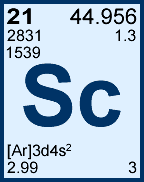
44.95591
+3, +2
Scandium
Group 3, Period 4
44.95591
(6)
Sc(H2O)6+2
+3, +2
Storage & Handling: Keep tightly sealed when not in use. Store and use at 20 ± 4°C. Do not pipet from container. Do not return portions removed for pipetting to container.
Chemical Compatibility: Soluble in HCl, H2SO4, and HNO3. Avoid HF, H3PO4, and neutral to basic media. Stable with most metals and inorganic anions forming an insoluble carbonate, oxide, oxalate, and fluoride. Avoid mixing with elements / solutions containing moderate amounts of fluoride. The fluoride is soluble in excess HF, forming ScF63- (not recommended for standard preparations).
Stability: 2-100 ppb levels stable for months in 1% HNO3 / LDPE container. 1-10,000 ppm solutions chemically stable for years in 5-10% HNO3 / LDPE container. Small atomic radius increases hydrolysis requiring higher acid levels than other Rare Earths.
Sc Containing Samples (Preparation & Solution): Metal (soluble in acids); Oxide (dissolved by heating in H2O / HNO3); Ores (carbonate fusion in Pt0 followed by HCl dissolution); Organic Matrices (dry ash and dissolve in 1:1 H2O / HCl or HNO3 - aqua regia or nitric / perchloric / sulfuric acid digestions can be used - exercise caution when using perchloric acid).
Atomic Spectroscopic Information:(red text indicates severe at ~ concs.)
| Technique / Line | Estimated D.L.* | Order | Type | Interferences |
| ICP-OES 335.373 nm | 0.004/.00002 µg/mL | 1 | ion | |
| ICP-OES 337.215 nm | 0.004/.00002 µg/mL | 1 | ion | Ti, U, Ni, Rh |
| ICP-OES 424.683 nm | 0.003/.00002 µg/mL | 1 | ion | Ce |
| ICP-MS 45 amu | 2.3 ppt | n/a | M+ | 16O212C1H, 29Si16O, 90Zr+2 |
| *ICP-OES D.L.'s are given as radial / axial view | ||||
4
IVB
IVB
22
Ti
Titanium
47.88
+4, +3, +2
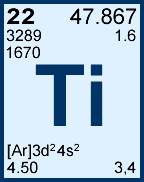
Titanium
Group 4, Period 4
47.88
(6)
Ti(F)6-2
+4, +3, +2
Storage & Handling: Keep tightly sealed when not in use. Store and use at 20 ± 4°C. Do not pipet from container. Do not return portions removed for pipetting to container.
Chemical Compatibility: Soluble in concentrated HCl, HF, H3PO4, H2SO4, and HNO3. Avoid neutral to basic media. Unstable at ppm levels with metals that would pull F- away (i.e. - do not mix with Alkaline or Rare Earths or high levels of transition elements unless they are fluorinated). Stable with most inorganic anions with a tendency to hydrolyze forming the hydrated oxide in all dilute acids except HF.
Stability: 2-100 ppb levels stable (alone or mixed with all other metals) as the Ti(F)6-2 for months in 1% HNO3 / LDPE container. 1-10,000 ppm single element solutions as the Ti(F)6-2 chemically stable for years in 2-5% HNO3 / trace HF in an LDPE container.
Ti Containing Samples (Preparation & Solution): Metal (soluble in H2O / HF CAUTION - powder reacts violently); Oxide - low temperature history anatase or rutile (dissolved by heating in 1:1:1 H2O / HF / H2SO4); Oxide - high temperature history {~ 800°C} brookite (fuse in Pt0 with K2S2O7); Ores (fuse in Pt0with KF + K2S2O7 - no KF if silica not present); Organic Matrices (dry ash at 450°C in Pt0 and dissolve by heating with 1:1:1 H2O / HF / H2SO4 or fuse ash with pyrosulfate if oxide is as plastic pigment and likely in brookite crystalline form).
Atomic Spectroscopic Information:(red text indicates severe at ~ concs.)
| Technique / Line | Estimated D.L.* | Order | Type | Interferences |
| ICP-OES 334.941 nm | 0.0038/.000028 µg/mL | 1 | ion | Nb, Ta, Cr, U |
| ICP-OES 336.121 nm | 0.0053/.000034 µg/mL | 1 | ion | W, Mo, Co |
| ICP-OES 323.452 nm | 0.0054/.00092 µg/mL | 1 | ion | Ce, Ar, Ni |
| ICP-MS 48 amu | 14 ppt | n/a | M+ | 32S16O, 34S14N, 14N16O18O, 14N17O2, 36Ar12C, 48Ca, [96X=2(where X = Zr, Mo, Ru)] |
| *ICP-OES D.L.'s are given as radial / axial view | ||||
5
VB
VB
23
V
Vanadium
50.9415
+5, +4, +3, +2, +1, 0, -1
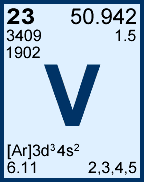
Vanadium
Group 5, Period 4
50.9415
(6)
H2V10O284-
+5, +4, +3, +2, +1, 0, -1
Storage & Handling: Keep tightly sealed when not in use. Store and use at 20 ± 4°C. Do not pipet from container. Do not return portions removed for pipetting to container.
Chemical Compatibility: Soluble in HCl, HNO3, H2SO4, HF, H3PO4, and strong basic media. Stable with most metals and inorganic anions in acidic media.
Stability: 2-100 ppb levels stable for months in 1% HNO3 / LDPE container. 1-10,000 ppm solutions chemically stable for years in 1-5% HNO3 / LDPE container.
V Containing Samples (Preparation & Solution): Metal (fusion with NaOH or KOH in Ni0 or Na2CO3 / KNO3); Oxides (V2O3 - use HCl; V2O4 - use HCl or HNO3; V2O5 - use conc. acids); Ores (Na2CO3 / KNO3 in Pt0 (caution - nitrates attack Pto) followed by water extraction of fuseate); Organic Matrices (ash at 450°C followed by dissolving according to V2O5 above).
Atomic Spectroscopic Information:(red text indicates severe at ~ concs.)
| Technique / Line | Estimated D.L.* | Order | Type | Interferences |
| ICP-OES 309.311 nm | 0.005/.001 µg/mL | 1 | ion | Mg, U, Th |
| ICP-OES 292.402 nm | 0.006/.001 µg/mL | 1 | ion | Th |
| ICP-OES 290.882 nm | 0.008/.0008 µg/mL | 1 | atom | Hf, Nb |
| ICP-MS 51 amu | 4 ppt | n/a | M+ | 34S16O1H, 35Cl16O, 38Ar13C, 36Ar15N, 36Ar14N1H, 37Cl14N, 36S15N, 33S18O, 34S17O, 102Ru+2, 102Pd+2 |
6
VIB
VIB
24
Cr
Chromium
51.9961
+6, +5, +4, +3, +2, +1, 0, -1, -2
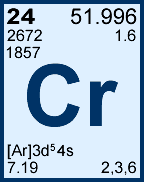
Chromium
Group 6, Period 4
51.9961
(6)
Cr(H2O)63+
+6, +5, +4, +3, +2, +1, 0, -1, -2
Storage & Handling: Keep tightly sealed when not in use. Store and use at 20 ± 4°C. Do not pipet from container. Do not return portions removed for pipetting to container.
Chemical Compatibility: Stable in HCl, HNO3, H2SO4, HF, H3PO4. Avoid basic media. Stable with most metals and inorganic anions in acidic media.
Stability: 2-100 ppb levels stable for months in 1% HNO3 / LDPE container. 1-10,000 ppm solutions chemically stable for years in 1-5% HNO3 / LDPE container.
Cr Containing Samples (Preparation & Solution): Metal (soluble in HCl); Oxides / Ores (chrome ore/oxides are very difficult to dissolve. The following procedures A - D are commonly used:
A. Fusion with KHSO4 and extraction with hot KCl. The residue fused with Na2CO3 and KClO3, 3:1
B. Fusion with NaKSO4 and NaF, 2:1
C. Fusion with magnesia or lime and sodium or potassium carbonates, 4:1
D. Fusion with Na2O2 or NaOH and KNO3 or NaOH and Na2O2.
Nickel, iron, copper, or silver crucibles should be used for D. Platinum may be used for A, B, and C; Organic Matrices (ash at 450°C followed by one of the fusion methods above or sulfuric / hydrogen peroxide acid digestions may be applicable to non oxide containing samples).
Atomic Spectroscopic Information:(red text indicates severe at ~ concs.)
| Technique / Line | Estimated D.L.* | Order | Type | Interferences |
| ICP-OES 205.552 nm | 0.006/.0008 µg/mL | 1 | ion | Os |
| ICP-OES 284.325 nm | 0.008/.0007 µg/mL | 1 | ion | |
| ICP-OES 276.654 nm | 0.01/.001 µg/mL | 1 | ion | Cu, Ta, V |
| ICP-MS 52 amu | 40 ppt | n/a | M- | 36S16O, 36Ar16O** |
| *ICP-OES D.L.'s are given as radial / axial view **The 50Cr, 53Cr, 54Cr lines suffer from many more potential interferences from sulfur, chlorine, and argon compounds of oxygen, nitrogen, and carbon. | ||||
7
VIIB
VIIB
25
Mn
Manganese
54.9380
+7, +6, +5, +4, +3, +2, +1, 0, -1
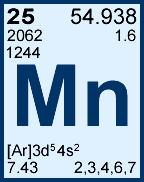
Manganese
Group 7, Period 4
54.9380
(6)
Mn(H2O)62+
+7, +6, +5, +4, +3, +2, +1, 0, -1
Storage & Handling: Keep tightly sealed when not in use. Store and use at 20 ± 4°C. Do not pipet from container. Do not return portions removed for pipetting to container.
Chemical Compatibility: Stable in HCl, HNO3, H2SO4, HF, and H3PO4. Avoid basic media. Stable with most metals and inorganic anions in acidic media.
Stability: 2-100 ppb levels stable for months in 1% HNO3 / LDPE container. 1-10,000 ppm solutions chemically stable for years in 1-5 % HNO3 / LDPE container.
Mn Containing Samples (Preparation & Solution): Metal (soluble in dilute acids); Oxides (soluble in dilute acids); Ores (dissolve with HCl. If silica is present, add HF and then fume off silica by adding H2SO4 and heat to SO3 fumes - dense white fumes).
Atomic Spectroscopic Information:(red text indicates severe at ~ concs.)
| Technique / Line | Estimated D.L.* | Order | Type | Interferences |
| ICP-OES 257.610 nm | 0.0014/.00002 µg/mL | 1 | ion | Ce, W, Re |
| ICP-OES 259.373 nm | 0.0016/.00002 µg/mL | 1 | ion | U, Ta, Mo, Fe, Nb |
| ICP-OES 260.569 nm | 0.0021/.00002 µg/mL | 1 | ion | Co |
| ICP-MS 55 amu | 10 ppt | n/a | M+ | 40Ar14N1H, 39K16O, 37Cl18O, 40Ar15N, 38Ar17O, 36Ar18O1H, 38Ar16O1H, 37Cl17O1H, 23Na32S |
| *ICP-OES D.L.'s are given as radial / axial view | ||||
8
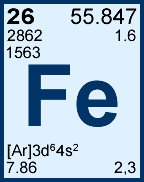
26
Fe
Iron
55.847
+6, +5, +4, +3, +2, +1, 0
Iron
Group 8, Period 4
55.847
(6)
Fe(H2O)63+
+6, +5, +4, +3, +2, +1, 0
Storage & Handling: Keep tightly sealed when not in use. Store and use at 20 ± 4°C. Do not pipet from container. Do not return portions removed for pipetting to container.
Chemical Compatibility: Stable in HCl, HNO3, H2SO4, HF, H3PO4. Avoid basic media. Stable with most metals and inorganic anions in acidic media.
Stability: 2-100 ppb levels stable for months in 1% HNO3 / LDPE container. 1-10,000 ppm solutions chemically stable for years in 1-5% HNO3 / LDPE container.
Fe Containing Samples (Preparation & Solution): Metal (soluble in HCl); Oxides (if the oxide has been at a high temperature then Na2CO3 fusion in Pt0 followed by HCl dissolution, otherwise dissolve in dilute HCl); Ores (see Oxides above using only the fusion approach).
Atomic Spectroscopic Information:(red text indicates severe at ~ concs.)
| Technique / Line | Estimated D.L.* | Order | Type | Interferences |
| ICP-OES 238.204 nm | 0.005/.001 µg/mL | 1 | ion | Ru, Co |
| ICP-OES 239.562 nm | 0.005/.001 µg/mL | 1 | ion | Co, W, Cr |
| ICP-OES 259.940 nm | 0.006/.001 µg/mL | 1 | ion | Hf, Nb |
| ICP-MS 56 amu | 970 ppt | n/a | M+ | 40Ar15N1H, 40Ar16O, 38Ar18O, 37Cl18O1H, 40Ca16O |
| *ICP-OES D.L.'s are given as radial / axial view | ||||
9
VIIII
VIIII
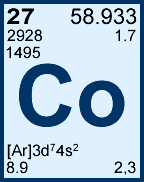
27
Co
Cobalt
58.9332
+5, +4, +3, +2
Cobalt
Group 9, Period 4
58.9332
(6)
Co(H2O)62+
+5, +4, +3, +2
Storage & Handling: Keep tightly sealed when not in use. Store and use at 20 ± 4°C. Do not pipet from container. Do not return portions removed for pipetting to container.
Chemical Compatibility: Stable in HCl, HNO3, H2SO4, HF and H3PO4. Avoid basic media. Stable with most metals and inorganic anions in acidic media.
Stability: 2-100 ppb levels stable for months in 1% HNO3 / LDPE container. 1-10,000 ppm solutions chemically stable for years in 1-5% HNO3 / LDPE container.
Co Containing Samples (Preparation & Solution): Metal (soluble in HNO3); Oxides (soluble in HCl); Ores (dissolve in HCl / HNO3).
Atomic Spectroscopic Information:(red text indicates severe at ~ concs.)
| Technique / Line | Estimated D.L.* | Order | Type | Interferences |
| ICP-OES 238.892 nm | 0.01/.002 µg/mL | 1 | ion | Fe, W, Ta |
| ICP-OES 228.616 nm | 0.01/.001 µg/mL | 1 | ion | |
| ICP-OES 237.862 nm | 0.01/.002 µg/mL | 1 | ion | W, Re, Al, Ta |
| ICP-MS 59 amu | 2 ppt | n/a | M+ | 42Ca16O1H, 40Ar18O1H, 36Ar23Na, 43Ca16O, 24Mg35Cl |
| *ICP-OES D.L.'s are given as radial / axial view | ||||
10
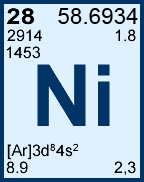
28
Ni
Nickel
58.6934
+6, +4, +3, +2, +1, 0, -1
Nickel
Group 10, Period 4
58.6934
(6)
Ni(H2O)62+
+6, +4, +3, +2, +1, 0, -1
Storage & Handling: Keep tightly sealed when not in use. Store and use at 20 ± 4°C. Do not pipet from container. Do not return portions removed for pipetting to container.
Chemical Compatibility: Stable in HCl, HNO3, H2SO4, HF, and H3PO4. Avoid basic media. Stable with most metals and inorganic anions in acidic media.
Stability: 2-100 ppb levels. 2-100 ppb levels stable for months in 1% HNO3 / LDPE container. 1-10,000 ppm solutions chemically stable for years in 1-5% HNO3 / LDPE container.
Ni Containing Samples (Preparation & Solution): Metal (soluble in HNO3); Oxides (soluble in HCl); Ores (dissolve in HCl / HNO3).
Atomic Spectroscopic Information:(red text indicates severe at ~ concs.)
| Technique / Line | Estimated D.L.* | Order | Type | Interferences |
| ICP-OES 221.647 nm | 0.01/.0009 µg/mL | 1 | ion | Si |
| ICP-OES 232.003 nm | 0.02/.006 µg/mL | 1 | atom | Cr, Re, Os, Nb, Ag, Pt, Fe |
| ICP-OES 231.604 nm | 0.02/.002 µg/mL | 1 | ion | Sb, Ta, Co |
| ICP-MS 60 amu | 100 ppt | n/a | M+ | 43Ca16O1H, 44Ca16O, 23Na37Cl |
| *ICP-OES D.L.'s are given as radial / axial view | ||||
11
IB
IB
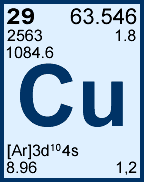
29
Cu
Copper
63.546
+3, +2, +1
Copper
Group 11, Period 4
63.546
(6)
Cu(H2O)62+
+3, +2, +1
Storage & Handling: Keep tightly sealed when not in use. Store and use at 20 ± 4°C. Do not pipet from container. Do not return portions removed for pipetting to container.
Chemical Compatibility: Stable in HCl, HNO3, H2SO4, HF, H3PO4. Avoid basic media. Stable with most metals and inorganic anions in acidic media.
Stability: 2-100 ppb levels stable for months in 1% HNO3 / LDPE container. 1-10,000 ppm solutions chemically stable for years in 1-5% HNO3 / LDPE container.
Cu Containing Samples (Preparation & Solution): Metal (soluble in HNO3); Oxides (soluble in HCl); Ores (dissolve in HCl / HNO3).
Atomic Spectroscopic Information:(red text indicates severe at ~ concs.)
| Technique / Line | Estimated D.L.* | Order | Type | Interferences |
| ICP-OES 324.754 nm | 0.06/.001 µg/mL | 1 | atom | Nb, U, Th, Mo, Hf |
| ICP-OES 224.700 nm | 0.01/.001 µg/mL | 1 | ion | Pb, Ir, Ni, W |
| ICP-OES 219.958 nm | 0.01/.002 µg/mL | 1 | atom | Th, Ta, Nb, U, Hf |
| ICP-MS 63 amu | 10 ppt | n/a | M+ | 40Ar23Na, 47Ti16O, 14N12C37Cl, 16O12C35Cl, 44Ca18O1H, 23Na40Ca |
| *ICP-OES D.L.'s are given as radial / axial view | ||||
12
IIB
IIB
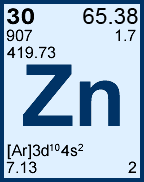
30
Zn
Zinc
65.38
+2
Zinc
Group 12, Period 4
65.38
(6)
Zn(OH)(aq)1+
+2
Storage & Handling: Keep tightly sealed when not in use. Store and use at 20 ± 4°C. Do not pipet from container. Do not return portions removed for pipetting to container.
Chemical Compatibility: Stable in HCl, HNO3, H2SO4, HF and H3PO4. Avoid basic media that promotes formation of insoluble carbonate and hydroxide. Stable with most metals and inorganic anions in acidic media.
Stability: 2-100 ppb levels stable for months in 1% HNO3 / LDPE container. 1-10,000 ppm solutions chemically stable for years in 1-5% HNO3 / LDPE container.
Zn Containing Samples (Preparation & Solution): Metal (soluble in HNO3); Oxides (soluble in HCl); Ores (dissolve in HCl / HNO3); Organic based (dry ash at 450°C and dissolve ash in HCl), (sulfuric / peroxide acid digestion).
Atomic Spectroscopic Information:(red text indicates severe at ~ concs.)
| Technique / Line | Estimated D.L.* | Order | Type | Interferences |
| ICP-OES 213.856 nm | 0.002/.0004 µg/mL | 1 | atom | Ni, Cu, V |
| ICP-OES 202.548 nm | 0.004/.0002 µg/mL | 1 | ion | Nb, Cu, Co, Hf |
| ICP-OES 206.200 nm | 0.006/.0006 µg/mL | 1 | ion | Sb, Ta, Bi, Os |
| ICP-MS 66 amu | 7 ppt | n/a | M- | 50Ti16O, 50Cr16O, 50V16O, 34S16O2, 32S16O18O, 32S17O2, 33S16O17O, 32S34S, 33S2 |
| *ICP-OES D.L.'s are given as radial / axial view | ||||
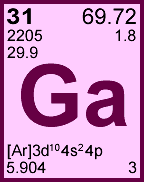
31
Ga
Gallium
69.723
+3, +2, +1
Gallium
Group 13, Period 4
69.723
(6)
Ga(H2O)6+3
+3, +2, +1
Storage & Handling: Keep tightly sealed when not in use. Store and use at 20 ± 4°C. Do not pipet from container. Do not return portions removed for pipetting to container.
Chemical Compatibility: Soluble in HCl, HNO3, and H2SO4. Avoid neutral media. Stable with most metals and inorganic anions. The fluoride is insoluble in water but soluble in HF.
Stability: 2-100 ppb levels stable for months in 1% HNO3 / LDPE container. 1-10,000 ppm solutions chemically stable for years in 2-5% HNO3 / LDPE container.
Ga Containing Samples (Preparation & Solution): Metal (is best dissolved in HCl / HNO3); Ga2O3(Na2CO3 fusion in Pt0); Ores (carbonate fusion in Pt0 followed by HCl dissolution); Organic Matrices (sulfuric / peroxide digestion or nitric / sulfuric / perchloric acid decomposition or dry ash and dissolution in dilute HCl).
Atomic Spectroscopic Information:(red text indicates severe at ~ concs.)
| Technique / Line | Estimated D.L.* | Order | Type | Interferences |
| ICP-OES 141.444 nm | 0.05/.001 µg/mL | 1 | ion | Hg |
| ICP-OES 294.364 nm | 0.05/.008 µg/mL | 1 | atom | Ce, U, Ni |
| ICP-OES 417.206 nm | 0.07/.005 µg/mL | 1 | atom | Ti, Ce |
| ICP-MS 69 amu | 2 ppt | n/a | M+ | 35Cl16O18O, 35Cl17O2, 37Cl16O2, 36Ar33S, 33S18O2, 34S17O18O, 36S16O17O, 33S36S, 53Cr16O, [138X2+ (where X = Ba, La, Ce)] |
| *ICP-OES D.L.'s are given as radial / axial view | ||||
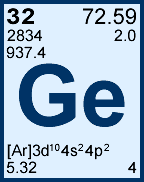
32
Ge
Germanium
72.59
+4, +2
Germanium
Group 14, Period 4
72.59
(6)
Ge(OH)x(F)y2-
+4, +2
Storage & Handling: Keep tightly sealed when not in use. Store and use at 20 ± 4°C. Do not pipet from container. Do not return portions removed for pipetting to container.
Chemical Compatibility: Stable in HCl, HF, H3PO4, H2SO4, and HNO3 as the Ge(OH)x(F)y2-. Avoid neutral to basic media. Unstable at ppm levels with metals that would pull F- away (i.e. - Do not mix with Alkaline or Rare Earths or high levels of transition elements unless they are fluorinated). Stable with most inorganic anions with a tendency to hydrolyze.
Stability: 2-100 ppb levels - stability unknown alone or mixed with all other metals as the Ge(OH)x(F)y2-. 1-10,000 ppm single element solutions as the Ge(OH)x(F)y2- chemically stable for years in 2-5% HNO3 / trace HF in a LDPE container.
Ge Containing Samples (Preparation & Solution): Metal (soluble in 1:1:1 H2O / HF / HNO3); Oxide - GeO (readily soluble in HCl or NaOH), GeO2 (fuse in Pt0with Na2CO3 followed by HCl solution of the fuseate); Geological Samples( fuse in Pt0 with Na2CO3 followed by HCl solution of the fuseate); Organic Matrices (dry ash at 450°C in Pt0 and dissolve by gently warming with 1:1:1 H2O / HF / H2SO4 or fuse ash with Na2CO3 and dissolve fuseate with HCl / H2O).
Atomic Spectroscopic Information:(red text indicates severe at ~ concs.)
| Technique / Line | Estimated D.L.* | Order | Type | Interferences |
| ICP-OES 164.919 nm | 0.01/.001 µg/mL | 1 | ion | Co, Fe, Cu |
| ICP-OES 219.871 nm | 0.06/.009 µg/mL | 1 | atom | W, Ir, Re, Co |
| ICP-OES 265.117 nm | 0.05/.009 µg/mL | 1 | atom | Ir, Re |
| ICP-MS 72 amu | 20 ppt | n/a | M+ | 36Ar2, 37Cl17O18O, 37Cl35Cl, 36S18O2, 36S2, 36Ar36S, 56Fe16O, 40Ar16O2, 40Ca16O2, 40Ar32S, 144Nd2+, 144Sm2+ |
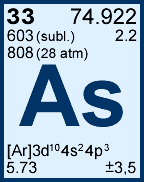
33
As
Arsenic
74.9216
+5/+3mix, -3
Arsenic
Group 15, Period 4
74.9216
(6)
H3AsO4 and HAsO2
+5/+3mix, -3
Storage & Handling: Keep tightly sealed when not in use. Store and use at 20 ± 4°C. Do not pipet from container. Do not return portions removed for pipetting to container.
Chemical Compatibility: Arsenic has no cationic chemistry. It is soluble in HCl, HNO3,H3PO4, H2SO4 and HF aqueous matrices water and NH4OH. It is stable with most inorganic anions (forms arsenate when boiled with chromate) but many cationic metals form the insoluble arsenates under pH neutral conditions. When fluorinated and/or under acidic conditions arsenate formation is typically not a problem at moderate to low concentrations.
Stability: 2-100 ppb levels - stable for months alone or mixed with other elements at equivalent levels - in 1% HNO3 / LDPE container. 1-10,000 ppm solutions chemically stable for years in 1-5% HNO3 / LDPE container.
As Containing Samples (Preparation & Solution): Metal (soluble in 1:1 H2O / HNO3); Oxides (the oxide exists in crystalline and amorphous forms where the amorphoric form is more water soluble. The oxides typically dissolve in dilute acidic solutions when boiled); Minerals (one gram of powered sample is fused in a Ni0 crucible with 10 grams of a 1:1 mix of K2CO3 and KNO3 and the melt extracted with hot water); Organic Matrices (0.2 to 0.5 grams of the sample are fused with 15 grams of a 1:1 Na2CO3 / Na2O2 mix in a Ni0 crucible. The fuseate is extracted with water and acidified with HNO3).
Atomic Spectroscopic Information:(red text indicates severe at ~ concs.)
| Technique / Line | Estimated D.L.* | Order | Type | Interferences |
| ICP-OES 189.042 nm | 0.05/.005 µg/mL | 1 | atom | Cr |
| ICP-OES 193.696 nm | 0.1/.01 µg/mL | 1 | atom | V, Ge |
| ICP-OES 228.812 nm | 0.1/.01 µg/mL | 1 | atom | Cd, Pt, Ir, Co |
| ICP-MS 75 amu | 30 ppt | n/a | M+ | 40Ar35Cl, 59Co16O, 36Ar38Ar1H, 38Ar37Cl, 36Ar39K, 150Nd2+, 150Sm2+ |
| *ICP-OES D.L.'s are given as radial / axial view | ||||
34
Se
Selenium
78.96
+6, +4, +1, -2
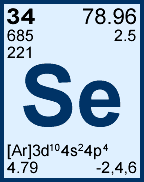
Selenium
Group 16, Period 4
78.96
(6)
H2SeO3
+6, +4, +1, -2
Storage & Handling: Keep tightly sealed when not in use. Store and use at 20 ± 4°C. Do not pipet from container. Do not return portions removed for pipetting to container.
Chemical Compatibility: Soluble in HCl, HNO3, H3PO4, H2SO4 and HF aqueous matrices and water. It is stable with most inorganic anions but many cationic metals form the insoluble selenites under pH neutral conditions. When fluorinated and/or under acidic conditions precipitation is typically not a problem at moderate to low concentrations.
Stability: 2-100 ppb levels stable for months alone or mixed with other elements at equivalent levels in 1 % HNO3 / LDPE container. 1-10,000 ppm solutions chemically stable for years in 1-5% HNO3 / LDPE container.
Se Containing Samples (Preparation & Solution): Metal (soluble in HNO3); Oxides (readily soluble in water); Minerals and alloys (acid digestion with HNO3or HNO3 / HF); Organic Matrices (acid digestion with hot concentrated H2SO4 accompanied by the careful dropwise addition of H2O2 until clear).
Atomic Spectroscopic Information:(red text indicates severe at ~ concs.)
| Technique / Line | Estimated D.L.* | Order | Type | Interferences |
| ICP-OES 196.026 nm | 0.08/0.006 µg/mL | 1 | atom | Fe |
| ICP-OES 203.985 nm | 0.2/.05 µg/mL | 1 | atom | Sb, Ir, Cr, Ta |
| ICP-OES 206.279 nm | 0.3/.16 µg/mL | 1 | atom | Cr, Pt |
| ICP-MS 82 amu | 200 ppt | n/a | M+ | 12C35Cl2 |
| *ICP-OES D.L.'s are given as radial / axial view | ||||
35
Br
Bromine
79.904
+7, +5, +4, +3, +1, -1
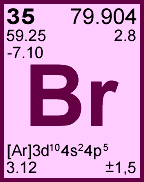
Bromine
79.904
+7, +5, +4, +3, +1, -1
36
Kr
X
Krypton
83.8
+2
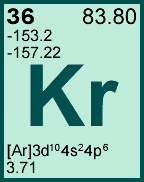
Krypton
83.8
+2
5
37
Rb
Rubidium
85.4678
+1
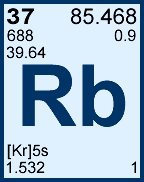
Rubidium
Group 1, Period 5
85.4678
(6)
(assumed, not certain)
Rb+(aq)
+1
Storage & Handling: Keep tightly sealed when not in use. Store and use at 20 ± 4°C. Do not pipet from container. Do not return portions removed for pipetting to container.
Chemical Compatibility: Soluble in HCl, HNO3, H2SO4, and HF aqueous matrices. Stable with most metals and inorganic anions. Forms insoluble Rb2[PtCl6] (0.028g/100mL 20aq).
Stability: 2-100 ppb levels stable for months in 1% HNO3 / LDPE container. 1-10,000 ppm solutions chemically stable for years in 0.1-1% HNO3 / LDPE container.
Rb Containing Samples (Preparation & Solution): Metal (dissolves very rapidly in water); Ores (sodium carbonate fusion in Pt0 followed by HCl dissolution - blank levels of Rb in sodium carbonate critical); Organic Matrices (sulfuric / peroxide digestion or nitric / sulfuric / perchloric acid decomposition).
Atomic Spectroscopic Information:(red text indicates severe at ~ concs.)
| Technique / Line | Estimated D.L.* | Order | Type | Interferences |
| ICP-OES 420.185 nm | 40/10 µg/mL | 1 | atom | Fe, Zr |
| ICP-MS 85 amu | 1.5 ppt | n/a | M+ | 69Ga16O, 170Er+2, 170Yb+2 |
| *ICP-OES D.L.'s are given as radial / axial view | ||||
38
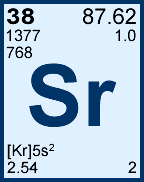
Sr
Strontium
87.62
+2
Strontium
Group 2, Period 5
87.62
(6)
Sr(H2O)6+2
+2
Storage & Handling: Keep tightly sealed when not in use. Store and use at 20 ± 4°C. Do not pipet from container. Do not return portions removed for pipetting to container.
Chemical Compatibility: Soluble in HCl and HNO3. Avoid H2SO4, HF and neutral to basic media. Stable with most metals and inorganic anions forming insoluble silicate, carbonate, hydroxide, oxide, fluoride, sulfate, oxalate, chromate, arsenate, and tungestate in neutral aqueous media.
Stability: 2-100 ppb levels stable for months in 1% HNO3 / LDPE container. 1-10,000 ppm solutions chemically stable for years in 1-3.5% HNO3 / LDPE container.
Sr Containing Samples (Preparation & Solution): Metal (is best dissolved in diluted HNO3);Ores (Carbonate fusion in Pt0 followed by HCl dissolution); Organic Matrices (dry ash and dissolution in dilute HCl. Do not heat when dissolving to avoid precipitation of SiO2).
Atomic Spectroscopic Information:(red text indicates severe at ~ concs.)
| Technique / Line | Estimated D.L.* | Order | Type | Interferences |
| ICP-OES 407.771 nm | 0.0004/.00006 µg/mL | 1 | ion | U, Ce |
| ICP-OES 421.552 nm | 0.0008/.00004 µg/mL | 1 | ion | Rb |
| ICP-OES 460.733 nm | 0.07/.003 µg/mL | 1 | atom | Ce |
| ICP-MS 88 amu | 1200 ppt | n/a | M+ | 72Ge16O, 176Yb+2, 176Lu+2, 176Hf+2 |
| *ICP-OES D.L.'s are given as radial / axial view | ||||
39
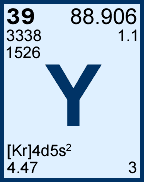
Y
Yttrium
88.9059
+3
Yttrium
Group 3, Period 5
88.9059
(6)
Y(OH)(H2O)x+2
+3
Storage & Handling: Keep tightly sealed when not in use. Store and use at 20 ± 4°C. Do not pipet from container. Do not return portions removed for pipetting to container.
Chemical Compatibility: Soluble in HCl, H2SO4, and HNO3. Avoid HF, H3PO4, and neutral to basic media. Stable with most metals and inorganic anions forming an insoluble carbonate, oxide, oxalate, and fluoride. Avoid mixing with elements / solutions containing moderate amounts of fluoride.
Stability: 2-100 ppb levels stable for months in 1% HNO3 / LDPE container. 1-10,000 ppm solutions chemically stable for years in 2-5% HNO3 / LDPE container.
Y Containing Samples (Preparation & Solution): Metal (soluble in acids); Oxide (dissolved by heating in H2O / HNO3); Ores (carbonate fusion in Pt0 followed by HCl dissolution); Organic Matrices (dry ash and dissolve in 1:1 H2O / HCl or HNO3).
Atomic Spectroscopic Information:(red text indicates severe at ~ concs.)
| Technique / Line | Estimated D.L.* | Order | Type | Interferences |
| ICP-OES 360.073 nm | 0.005/.000036 µg/mL | 1 | ion | Ce, Th |
| ICP-OES 371.030 nm | 0.004/.00007 µg/mL | 1 | ion | Ce |
| ICP-OES 377.433 nm | 0.005/.0009 µg/mL | 1 | ion | Ta, Th |
| ICP-MS 89 amu | 0.8 ppt | n/a | M+ | 73Ge16O, 178Hf+2 |
| *ICP-OES D.L.'s are given as radial / axial view | ||||
40
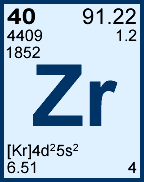
Zr
Zirconium
91.224
+4, +3, +2, 0, -2
Zirconium
Group 4, Period 5
91.224
(6), (7), (8)
(green are observed less frequently)
Zr(F)6-2
+4, +3, +2, 0, -2
Storage & Handling: Keep tightly sealed when not in use. Store and use at 20 ± 4°C. Do not pipet from container. Do not return portions removed for pipetting to container.
Chemical Compatibility: Soluble in concentrated HCl, HF, H2SO4 (very hot) and HNO3. Avoid H3PO4 and neutral to basic media. Unstable at ppm levels with metals that would pull F- away (i.e. - do not mix with Alkaline or Rare Earths or high levels of transition elements unless they are fluorinated). Stable with most inorganic anions but precipitation with phosphate, oxalate, and tartrate with a tendency to hydrolyze forming the hydrated oxide in all dilute acids except HF.
Stability: 2-100 ppb levels stable (alone or mixed with all other metals that are at comparable levels) as the Zr(F)6-2 + Zr(OH)4F2-2 for months in 1% HNO3 / LDPE container. 1-10,000 ppm single element solutions as the Zr(F)6-2 chemically stable for years in 2-5% HNO3 / trace HF in an LDPE container.
Zr Containing Samples (Preparation & Solution): Metal (soluble in H2O / HF / HNO3); Oxide unlike TiO2, the ZrO2 is best fused in one of the following ways (Na2O2 in Ni0, Na2CO3 in Pt0 or Borax in Pt0); Organic Matrices (dry ash at 450°C in Pt0 and dissolve by fusing with Na2CO3 and dissolving in HF / HNO3 / H2O).
Atomic Spectroscopic Information:(red text indicates severe at ~ concs.)
| Technique / Line | Estimated D.L.* | Order | Type | Interferences |
| ICP-OES 343.823 nm | 0.007/.0004 µg/mL | 1 | ion | Hf, Nb |
| ICP-OES 339.198 nm | 0.008/.0007 µg/mL | 1 | ion | Th, Mo |
| ICP-OES 272.261 nm | 0.018/.001 µg/mL | 1 | ion | Cr, V, Th, W |
| ICP-MS 90 amu | 2 ppt | n/a | M+ | 74Ge16O, 74Se16O, [180X+2 (where X = Hf, Ta, W)] |
| *ICP-OES D.L.'s are given as radial / axial view | ||||
41
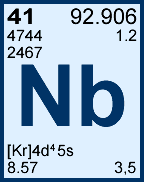
Nb
Niobium
92.9064
+5, +4, +3, +2, +1, -1, -3
Niobium
Group 5, Period 5
92.9064
(6), (7), (8)
(green are observed less frequently)
NbOF5-2
+5, +4, +3, +2, +1, -1, -3
Storage & Handling: Keep tightly sealed when not in use. Store and use at 20 ± 4°C. Do not pipet from container. Do not return portions removed for pipetting to container.
Chemical Compatibility: Soluble in concentrated HCl and dilute HF / HNO3. Avoid neutral to basic media. Unstable at ppm levels with metals that would pull F- away (i.e. - Do not mix with Alkaline or Rare Earths or high levels of transition elements unless they are fluorinated). Stable with most inorganic anions provided it is in the chemical form shown above.
Stability: 2-100 ppb levels stable (alone or mixed with all other metals that are at comparable levels) as the NbOF5-2 for 5 months in 1% HNO3 / LDPE container. 1-10,000 ppm single element solutions as the NbOF5-2 chemically stable for years in 2-5% HNO3 / trace HF in an LDPE container.
Nb Containing Samples (Preparation & Solution): Metal (soluble in HF / HNO3); Oxide - very resistant to all acids including HF (fusion with K2S2O7, KOH, or Na2CO3); Organic Matrices (dry ash at 450°C in Pt0and dissolve by fusing with Na2CO3 or K2S2O7).
Atomic Spectroscopic Information:(red text indicates severe at ~ concs.)
| Technique / Line | Estimated D.L.* | Order | Type | Interferences |
| ICP-OES 309.418 nm | 0.04/.002 µg/mL | 1 | ion | |
| ICP-OES 269.706 nm | 0.07/.002 µg/mL | 1 | ion | Th, Co |
| ICP-OES 295.088 nm | 0.08/.001 µg/mL | 1 | ion | Hf, U |
| ICP-MS 93 amu | 1 ppt | n/a | M+ | 77Se16O, 74Se16O, [186X+2 (where X = W, Os)] |
| *ICP-OES D.L.'s are given as radial / axial view | ||||
42
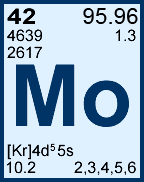
Mo
Molybdenum
95.96
+6, +5, +4, +3, +2
Molybdenum
Group 6, Period 5
95.96
(6), (7), (8), (9)
(green are observed less frequently)
MoO4-2 (chem. form as received)
+6, +5, +4, +3, +2
Storage & Handling: Keep tightly sealed when not in use. Store and use at 20 ± 4°C. Do not pipet from container. Do not return portions removed for pipetting to container.
Chemical Compatibility: Mo is received in a NH4OH matrix, giving the operator the option of using HCl or HF to stabilize acidic solutions. The MoO4-2 is soluble in concentrated HCl, MoOCl5-2, dilute HF / HNO3, MoOF5-2, and basic media MoO4-2. Stable at ppm levels with some metals, provided it is fluorinated. Do not mix with Alkaline or Rare Earths when HF is present. Stable with most inorganic anions, provided it is in the MoO4-2 chemical form.
Stability: 2-100 ppb levels stable (alone or mixed with all other metals that are at comparable levels) as the MoOF5-2 for months in 1% HNO3 / LDPE container. 1-10,000 ppm single element solutions as the MoO4-2 chemically stable for years in 1% NH4OH in a LDPE container.
Mo Containing Samples (Preparation & Solution): Metal (soluble in HF / HNO3 or hot dilute HCl); Oxide (soluble in HF or NH4OH); Organic Matrices (dry ash at 450°C in Pt0 and dissolve oxide with HF or HCl).
Atomic Spectroscopic Information:(red text indicates severe at ~ concs.)
| Technique / Line | Estimated D.L.* | Order | Type | Interferences |
| ICP-OES 202.030 nm | 0.008/.0002 µg/mL | 1 | ion | Os, Hf |
| ICP-OES 203.844 nm | 0.012/.002 µg/mL | 1 | ion | |
| ICP-OES 204.598 nm | 0.012/.001 µg/mL | 1 | ion | Ir, Ta |
| ICP-MS 95 amu | 3 ppt | n/a | M+ | 40Ar39K16O, 79Br16O, 190Os2+, 190Pt2+ |
| *ICP-OES D.L.'s are given as radial / axial view | ||||
43
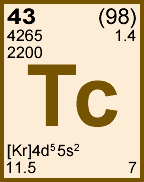
Tc
X
Technetium
(98)
+7, +6, +5, +4, 0, -1
Technetium
(98)
+7, +6, +5, +4, 0, -1
44
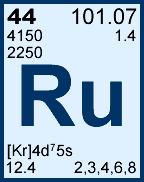
Ru
Ruthenium
101.07
+8, +7, +6, +5, +4, +3, +2
Ruthenium
Group 8, Period 5
101.07
(4), (5), (6), (8)
(green are observed less frequently)
[RuCl6]2-
+8, +7, +6, +5, +4, +3, +2
Storage & Handling: Keep tightly sealed when not in use. Store and use at 20 ± 4°C. Do not pipet from container. Do not return portions removed for pipetting to container.
Chemical Compatibility: Stable in HCl. Stable with most metals and inorganic anions as the [RuCl6]2- in dilute acidic media.
Stability: 2-100 ppb levels stable for months in 1% HNO3 / LDPE container. 1-10,000 ppm solutions chemically stable for years in 10% HCl / LDPE container.
Ru Containing Samples (Preparation & Solution): Metal (fuse with KOH/KNO3 in a Ag0 crucible); Oxides (fuse with KOH / KNO3 in a Ag0 crucible); Ores (see Oxides); Alloys (see Oxides). Organics (the RuO4 is volatile and acidic oxidizing preparations should be used with caution. The preferred approach is the KOH / KNO3 fusion and dissolution of the fuseate in HCl).
Atomic Spectroscopic Information:(red text indicates severe at ~ concs.)
| Technique / Line | Estimated D.L.* | Order | Type | Interferences |
| ICP-OES 240.272 nm | 0.03/.002 µg/mL | 1 | ion | Fe |
| ICP-MS 101 amu | 3 ppt | n/a | M+ | 40Ar61Ni, 64Ni37Cl, 85Rb16O, 202Hg2+ |
| *ICP-OES D.L.'s are given as radial / axial view | ||||
45
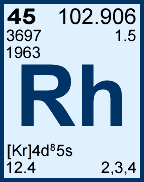
Rh
Rhodium
102.91
+6, +5, +4, +3, +2, +1, 0, -1
Rhodium
Group 9, Period 5
102.91
(6)
RhCl6-3
+6, +5, +4, +3, +2, +1, 0, -1
Storage & Handling: Keep tightly sealed when not in use. Store and use at 20 ± 4°C. Do not pipet from container. Do not return portions removed for pipetting to container.
Chemical Compatibility: Soluble in HCl, HNO3, H2SO4 and HF aqueous matrices. May cause AgClprecipitation when mixed with Ag+. Stable with all other metals.
Stability: 2-100 ppb levels stable for months in 1% HNO3 / LDPE container. 1-10,000 ppm solutions chemically stable for years in 10% HCl/LDPE container.
Rh Containing Samples (Preparation & Solution): Metal (elevated temp. with aqua regia or HCl / Cl2(gas) ); Ores (HF / H2SO4 digestion followed by aqua regia digestion); Platinum scrap (aqua regia digestion).
Atomic Spectroscopic Information:(red text indicates severe at ~ concs.)
| Technique / Line | Estimated D.L.* | Order | Type | Interferences |
| ICP-OES 233.477 nm | 0.04/0.004 µg/mL | 1 | ion | Ni, Sn, Mo, Nb, Ta |
| ICP-OES 249.077 nm | 0.06/0.006 µg/mL | 1 | ion | Ta, Co, Fe, W, Cr, Os |
| ICP-OES 343.489 nm | 0.06/0.006 µg/mL | 1 | atom | Mo, Th, Ce |
| ICP-MS 103 amu, monoisotopic | 1 ppt | n/a | M+ | 40Ar63Cu, 87Rb16O, 87Sr16O, 206Pb+2 |
| *ICP-OES D.L.'s are given as radial / axial view | ||||
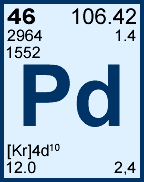
46
Pd
Palladium
106.42
+4, +2, 0
Palladium
Group 10, Period 5
106.42
(6)
Pd(H2O)62+
+4, +2, 0
Storage & Handling: Keep tightly sealed when not in use. Store and use at 20 ± 4°C. Do not pipet from container. Do not return portions removed for pipetting to container.
Chemical Compatibility: Stable in HCl, HNO3, H2SO4, HF, and H3PO4. Avoid basic media. Stable with most metals and inorganic anions in acidic media. Avoid contact with water soluble organics such as aldehydes since Pd2+ is easily reduced.
Stability: 2-100 ppb levels. 2 ppb Pd is stable for 1 day in 1% HNO3 / LDPE container. 10 ppb is stable for 3 days in 1% HNO3 / LDPE container. 100 ppb is stable for ≥ 5 months in 1% HNO3 / LDPE container. 1-10,000 ppm solutions chemically stable for years in 1-5% HNO3 / LDPE container.
Pd Containing Samples (Preparation & Solution): Metal (soluble in HNO3 or aqua regia); Oxides (soluble in HCl); Ores (dissolve in HCl / HNO3).
Atomic Spectroscopic Information:(red text indicates severe at ~ concs.)
| Technique / Line | Estimated D.L.* | Order | Type | Interferences |
| ICP-OES 340.458 nm | 0.04/.003 µg/mL | 1 | atom | Ce, Th, Zr |
| ICP-OES 363.470 nm | 0.05/.007 µg/mL | 1 | atom | |
| ICP-OES 229.651 nm | 0.07/.004 µg/mL | 1 | ion | Co |
| ICP-MS 105 amu | 2 ppt | n/a | M+ | 40Ar65Cu, 89Y16O |
| *ICP-OES D.L.'s are given as radial / axial view | ||||
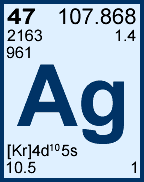
47
Ag
Silver
107.8682
+3, +2, +1
Silver
Group 11, Period 5
107.8682
(6)
Ag(H2O)6+
+3, +2, +1
Storage & Handling: Keep tightly sealed when not in use. Store and use at 20 ± 4°C. Do not pipet from container. Do not return portions removed for pipetting to container.
Chemical Compatibility: Stable in HNO3 and HF. Avoid basic media. Ag forms more insoluble salts than any other metal. It also is subject to photochemical reduction to the metal in HCl media although 10 µg/mL solutions in 10% HCl [AgClx1-x] are commonly used in the analytical laboratory. The most common solubility problems exist with arsenate, arsenite, bromide, chloride, iodide, carbonate, chromate, cyanide, iodate, oxalate, oxide, sulfate, sulfide, tartrate, and thiocyanate in aqueous media. The addition of nitric acid renders many of these salts soluble.
Stability: 2-100 ppb levels stable for 75+ days when mixed with equivalent levels of all other elements including the precious metals (where chloride is present) when in 1% HNO3 / LDPE container. 1-10,000 ppm solutions chemically stable for years in 1-5% HNO3 / LDPE container.
Ag Containing Samples (Preparation & Solution): Metal (soluble in HNO3); Oxides (soluble in HNO3); Ores (digestion with conc. HNO3).
Atomic Spectroscopic Information:(red text indicates severe at ~ concs.)
| Technique / Line | Estimated D.L.* | Order | Type | Interferences |
| ICP-OES 328.068 nm | 0.007/.0007 µg/mL | 1 | atom | Ce, Rh, V |
| ICP-OES 338.289 nm | 0.013/.001 µg/mL | 1 | atom | Ce, Cr, Th |
| ICP-OES 243.779 nm | 0.12/.01 µg/mL | 1 | ion | Mn, Th, Ni, Rh |
| ICP-MS 107 amu | 1 ppt | n/a | M+ | 91Zr16O |
| *ICP-OES D.L.'s are given as radial / axial view | ||||
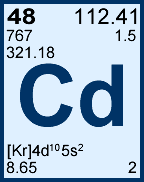
48
Cd
Cadmium
112.41
+2
Cadmium
Group 12, Period 5
112.41
(4)
Cd2(OH)(aq)3+ and Cd(OH)(aq)1+
+2
Storage & Handling: Keep tightly sealed when not in use. Store and use at 20 ± 4°C. Do not pipet from container. Do not return portions removed for pipetting to container.
Chemical Compatibility: Stable in HCl, HNO3, H2SO4, and HF. Avoid basic media forming insoluble carbonate and hydroxide. Stable with most metals and inorganic anions in acidic media. The sulfide, carbonate, oxalate, phosphate, and cyanide are insoluble in water and soluble in HCl, HNO3, and NH4OH. The chloride, bromide, and iodide are soluble in water. CdI2 is one of the few iodides soluble in ethanol. All compounds of Cd are soluble in excess NaI, due to the formation of the complex ion, CdI42-.
Stability: 2-100 ppb levels stable for months in 1% HNO3 / LDPE container. 1-10,000 ppm solutions chemically stable for years in 1-5 % HNO3 / LDPE container.
Cd Containing Samples (Preparation & Solution): Metal (soluble in HNO3); Oxides (soluble in HCl or HNO3); Ores (dissolve in HCl /HNO3 then take to fumes with H2SO4. The silica and lead sulfate are filtered off after the addition of water); Organic based (dry ash at 450°C and dissolve ash in HCl), (sulfuric / peroxide acid digestion).
Atomic Spectroscopic Information:(red text indicates severe at ~ concs.)
| Technique / Line | Estimated D.L.* | Order | Type | Interferences |
| ICP-OES 214.438 nm | 0.003/.0003 µg/mL | 1 | ion | Pt, Ir |
| ICP-OES 228.802 nm | 0.003/.0003 µg/mL | 1 | atom | Co, Ir, As, Pt |
| ICP-OES 226.502 nm | 0.003/.0003 µg/mL | 1 | ion | Ir |
| ICP-MS 111 amu | 11 ppt | n/a | M+ | 95Mo16O |
| *ICP-OES D.L.'s are given as radial / axial view | ||||
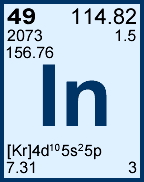
49
In
Indium
114.82
+3, +2, +1
Indium
Group 13, Period 5
114.82
(6)
In(H2O)6+3
+3, +2, +1
Storage & Handling: Keep tightly sealed when not in use. Store and use at 20 ± 4°C. Do not pipet from container. Do not return portions removed for pipetting to container.
Chemical Compatibility: Soluble in HCl, HNO3, and H2SO4. Avoid neutral and basic media. Stable with most metals and inorganic anions. The oxalate, sulfide, carbonate, hydroxide, and phosphate are insoluble in water.
Stability: 2-100 ppb levels stable for months in 1% HNO3 / LDPE container. 1-10,000 ppm solutions chemically stable for years in 2-5% HNO3 / LDPE container.
In Containing Samples (Preparation & Solution): Metal (is best dissolved in HCl / HNO3); Oxide (soluble in mineral acids); Ores (carbonate fusion in Pt0 followed by HCl dissolution); Organic Matrices (sulfuric / peroxide digestion or dry ash and dissolution in dilute HCl).
Atomic Spectroscopic Information:(red text indicates severe at ~ concs.)
| Technique / Line | Estimated D.L.* | Order | Type | Interferences |
| ICP-OES 158.583 nm | 0.05/.002 µg/mL | 1 | ion | |
| ICP-OES 230.606 nm | 0.1/.03 µg/mL | 1 | ion | Ni, Os |
| ICP-OES 325.609 nm | 0.2/.05 µg/mL | 1 | atom | Ir, Re |
| ICP-MS 115 amu | 1 ppt | n/a | M+ | 115Sn, 99Ru16O |
| *ICP-OES D.L.'s are given as radial / axial view | ||||
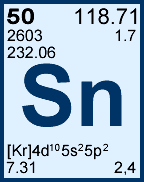
50
Sn
Tin
118.710
+4, +2
Tin
Group 14, Period 5
118.710
(4), (5), (6), (7), (8)
(green are observed less frequently)
Sn(OH)xFy2-
+4, +2
Storage & Handling: Keep tightly sealed when not in use. Store and use at 20 ± 4°C. Do not pipet from container. Do not return portions removed for pipetting to container.
Chemical Compatibility: Soluble in HCl and dilute HF / HNO3. Avoid neutral to basic media. Unstable at ppm levels with metals that would pull F- away (i.e. - do not mix with Alkaline or Rare Earths or high levels of transition elements unless they are fluorinated). Stable with most inorganic anions, provided it is in the chemical form shown above.
Stability: 2-100 ppb levels stable (alone or mixed with all other metals that are at comparable levels) as the Sn(OH)xFy2- for 1 year in 1% HNO3 / LDPE container. 1-10,000 ppm single element solutions as the Sn(OH)xFy2- are chemically stable for years in 2-5% HNO3 / trace HF in a LDPE container.
Sn Containing Samples (Preparation & Solution): Metal (soluble in HF / HNO3 or HCl); Oxides - SnO (soluble in HCl), SnO2 - very resistant to all acids including HF (fusion with equal parts of Na2CO3 and S is soluble in water or dilute acids as the thiostannate); Alloys (treat first 0.1 g with 10 mL conc. H2SO4 to boiling until the alloy disintegrates and nearly all of the sulfuric acid is expelled. Then add 100 mL O2 free water and 50 mL of conc. HCl or transfer to a plastic container and add 1 mL HF, in either case, warming gently to bring about solution); Organic Matrices (volatility and precipitation of the insoluble stannic oxide are problems -- because these preparations are prone to error, we recommend you contact our technical staff at sales@esslab.com or 01702 555577 and we'll provide you with the necessary data for your specific sample type).
Atomic Spectroscopic Information:(red text indicates severe at ~ concs.)
| Technique / Line | Estimated D.L.* | Order | Type | Interferences |
| ICP-OES 189.989 nm | 0.03/.003 µg/mL | 1 | ion | |
| ICP-OES 242.949 nm | 0.1/.01 µg/mL | 1 | atom | W, Mo, Rh ,Ta, Co |
| ICP-MS 120 amu | 5 ppt | n/a | M+ | 120Te, 104Ru16O, 104Pd16O |
| *ICP-OES D.L.'s are given as radial / axial view | ||||
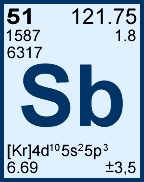
51
Sb
Antimony
121.75
+5, +3, -3
Antimony
Group 15, Period 5
121.75
(6)
Sb(O)C4H4O6-1
+5, +3, -3
Storage & Handling: Keep tightly sealed when not in use. Store and use at 20 ± 4°C. Do not pipet from container. Do not return portions removed for pipetting to container.
Chemical Compatibility: Stable in conc. HCl, dilute or conc. HF. Stable in dilute HNO3 as the fluoride or tartrate complex. Avoid basic media. Stable with most metals and inorganic anions in acidic media as the tartrate provided the acidity is not too high or the acid is oxidizing causing loss of the stabilizing tartrate ion. The fluoride complex of antimony is stable in strong acid but you should only mix with other metals that are fluorinated.
Stability: 2-100 ppb levels stable for months in 1% HNO3 / LDPE container. 1-10,000 ppm solutions chemically stable for years in 1-2% HNO3 / LDPE container.
Sb Containing Samples (Preparation & Solution): Metal and alloys (soluble in H2O / HF / HNO3 mixture); Oxides (soluble in HCl and tartaric acid or H2O / HF / HNO3 mixtures); Ores (fusion with Na2CO3 in Pt0followed by dissolving the fuseate in a H2O / HF / HNO3 mixture); Organic based (sulfuric acid / hydrogen peroxide digestion).
Atomic Spectroscopic Information:(red text indicates severe at ~ concs.)
| Technique / Line | Estimated D.L.* | Order | Type | Interferences |
| ICP-OES 206.833 nm | 0.03/.003 µg/mL | 1 | atom | Ta, Cr, Ge, Hf |
| ICP-OES 217.581 nm | 0.05/.005 µg/mL | 1 | atom | Nb, W, Re, Fe |
| ICP-OES 231.147 nm | 0.06/.006 µg/mL | 1 | atom | Ni, Co, Pt |
| ICP-MS 121 amu | 5 ppt | n/a | M+ | 105Pd16O, 89Y16O2 |
| *ICP-OES D.L.'s are given as radial / axial view | ||||
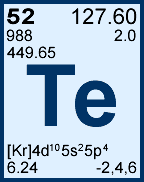
52
Te
Tellurium
127.60
+6, +5, +4, +2, -1, -2
Tellurium
Group 16, Period 5
127.60
(6)
H2TeO3 (HNO3 matrix), TeCl62- (HCl matrix)
+6, +5, +4, +2, -1, -2
Storage & Handling: Keep tightly sealed when not in use. Store and use at 20 ± 4°C. Do not pipet from container. Do not return portions removed for pipetting to container.
Chemical Compatibility: Soluble in HCl, HNO3, H3PO4, H2SO4 and HF aqueous matrices and water. It is stable with most inorganic anions and cations. Avoid mixing HCl matrices with elements forming insoluble chlorides such as Ag+. When fluorinated and/or under acidic conditions precipitation is typically not a problem at moderate to low concentrations.
Stability: 2-100 ppb levels stable for months alone or mixed with other elements at equivalent levels in 1% HNO3 / LDPE container. 1-10,000 ppm solutions chemically stable for years in 1-5% HNO3 / LDPE container.
Te Containing Samples (Preparation & Solution): Metal (soluble in solutions of alkali hydroxides or a 1:1:1 mixture of H2O, H2SO4, HNO3); Oxides (TeO2 is soluble in HCl and the alkali hydroxides. TeO3is soluble in hot concentrated solutions of the alkali hydroxides.); Minerals and alloys (acid digestion with HNO3or HNO3 / HF); Organic Matrices (Vegetable Matter - dry ash 100 g of the well-ground and mixed vegetation into a concentrated solution of 25 g of magnesium nitrate and magnesium oxide. Dry, ignite and muffle until the ash is a uniform gray color).
Atomic Spectroscopic Information:(red text indicates severe at ~ concs.)
| Technique / Line | Estimated D.L.* | Order | Type | Interferences |
| ICP-OES 170.000 nm | 0.04/.004 µg/mL | 1 | atom | Sn |
| ICP-OES 214.281 nm | 0.04/.004 µg/mL | 1 | atom | Ta, Re, V |
| ICP-OES 225.902 nm | 0.20/.02 µg/mL | 1 | atom | Ir, Os W, Ga, Ru, Ta |
| ICP-MS 130 amu | 20 ppt | n/a | M+ | 114Cd16O, 114Sn16O |
| *ICP-OES D.L.'s are given as radial / axial view | ||||
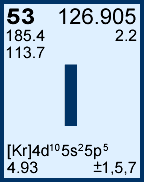
53
I
iodine
126.905
+7, +5, +3, +1, 0, -1
iodine
126.905
+7, +5, +3, +1, 0, -1
54
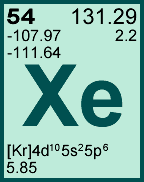
Xe
X
Xenon
131.29
+8, +6, +4, +2
Xenon
131.29
+8, +6, +4, +2
6
55
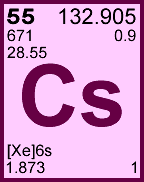
Cs
Cesium
132.9054
+1
Cesium
Group 1, Period 6
132.9054
(6)
(assumed, not certain)
Cs+(aq)
+1
Storage & Handling: Keep tightly sealed when not in use. Store and use at 20 ± 4°C. Do not pipet from container. Do not return portions removed for pipetting to container.
Chemical Compatibility: Soluble in dilute HCl, HNO3, H2SO4 and HF aqueous matrices. Stable with most metals and inorganic anions. Forms insoluble Cs2[PtCl6].
Stability: 2-100 ppb levels stable for months in 1% HNO3 / LDPE container. 1-10,000 ppm solutions chemically stable for years in 0.1% HNO3 / LDPE container. Will crystallize out of higher (~ 5%) levels of HNO3 at > 1000 µg/mL.
Cs Containing Samples (Preparation & Solution): Metal (dissolves very rapidly in water); Ores (sodium carbonate fusion in Pt0 followed by HCl dissolution - blank levels of Cs in sodium carbonate critical); Organic Matrices (sulfuric / peroxide digestion or nitric / sulfuric / perchloric acid decomposition).
Atomic Spectroscopic Information:(red text indicates severe at ~ concs.)
| Technique / Line | Estimated D.L.* | Order | Type | Interferences |
| ICP-OES 455.531 nm | 100/2 µg/mL | 1 | atom | Cr, U, Ce, Ti |
| ICP-MS 133 amu | 1.7 ppt | n/a | M+ | 117Sn16O |
| *ICP-OES D.L.'s are given as radial / axial view | ||||
56
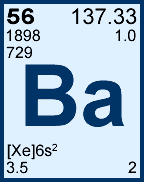
Ba
Barium
137.33
+2
Barium
Group 2, Period 6
137.33
(6)
Ba(H2O)6+2
+2
Storage & Handling: Keep tightly sealed when not in use. Store and use at 20 ± 4°C. Do not pipet from container. Do not return portions removed for pipetting to container.
Chemical Compatibility: Soluble in HCl and HNO3. Avoid H2SO4, HF, and neutral to basic media. Stable with most metals and inorganic anions forming insoluble silicate, carbonate, hydroxide, oxide, fluoride, sulfate, oxalate, chromate, arsenate, iodate, molybdate, sulfite and tungstate in neutral aqueous media.
Stability: 2-100 ppb levels stable for months in 1% HNO3 / LDPE container. 1-10,000 ppm solutions chemically stable for years in 1-3.5% HNO3 / LDPE container.
Ba Containing Samples (Preparation & Solution): Metal (is best dissolved in diluted HNO3); Ores (carbonate fusion in Pt0 followed by HCl dissolution. If sulfate is present dissolve the fuseate using HCl / tartaric acid to prevent BaSO4 precipitate); Organic Matrices (dry ash and dissolve in dilute HCl. Do not heat when dissolving to avoid precipitation of SiO2).
Atomic Spectroscopic Information:(red text indicates severe at ~ concs.)
| Technique / Line | Estimated D.L.* | Order | Type | Interferences |
| ICP-OES 455.403 nm | 0.002/.0001 µg/mL | 1 | ion | Zr, U |
| ICP-OES 233.527 nm | 0.004/.0003 µg/mL | 1 | ion | |
| ICP-OES 230.424 nm | 0.004/.0005 µg/mL | 1 | ion | Mo, Ir, Co |
| ICP-MS 138 amu | 1 ppt | n/a | M+ | 122Sn16O, 122Te16O |
| *ICP-OES D.L.'s are given as radial / axial view | ||||
72
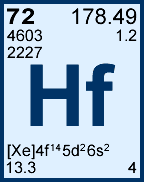
Hf
Hafnium
178.49
+4, +3
Hafnium
Group 4, Period 6
178.49
(6), (7), (8)
(green are observed less frequently)
Hf(F)6-2
+4, +3
Storage & Handling: Keep tightly sealed when not in use. Store and use at 20 ± 4°C. Do not pipet from container. Do not return portions removed for pipetting to container.
Chemical Compatibility: Soluble in concentrated HCl, HF, H2SO4 (very hot), and HNO3. Avoid H3PO4and neutral to basic media. Unstable at ppm levels with metals that would pull F- away (i.e. - do not mix with Alkaline or Rare Earths or high levels of transition elements unless they are fluorinated). Stable with most inorganic anions but precipitation with phosphate, oxalate, and tartrate with a tendency to hydrolyze forming the hydrated oxide in all dilute acids except HF.
Stability: 2-100 ppb levels stable alone or mixed with all other metals that are at comparable levels as the Hf(F)6-2 + Hf(OH)4F2-2 for months in 1% HNO3 / LDPE container. 1-10,000 ppm single element solutions as the Hf(F)6-2 chemically stable for years in 2-5% HNO3 / trace HF in an LDPE container.
Hf Containing Samples (Preparation & Solution): Metal (soluble in H2O / HF / HNO3); Oxide - unlike TiO2the HfO2 is best fused in one of the following ways (Na2O2 in Ni0, Na2CO3 in Pt0 or Borax in Pt0); Organic Matrices (dry ash at 450°C in Pt0 and dissolve by fusing with Na2CO3 and dissolving in HF / HNO3 / H2O).
Atomic Spectroscopic Information:(red text indicates severe at ~ concs.)
| Technique / Line | Estimated D.L.* | Order | Type | Interferences |
| ICP-OES 277.336 nm | 0.02/.002 µg/mL | 1 | ion | Nb, Cr, U |
| ICP-OES 273.876 nm | 0.02/.002 µg/mL | 1 | ion | U, Mo |
| ICP-OES 264.141 nm | 0.02/.002 µg/mL | 1 | ion | Ba, Th, U |
| ICP-MS 177 amu | 4 ppt | n/a | M+ | 161Dy16O** |
| *ICP-OES D.L.'s are given as radial / axial view **Fewer potential interferences on the 177 vs 180 mass | ||||
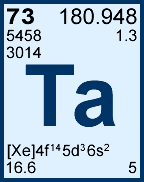
73
Ta
Tantalum
180.9479
+5, +4, +3, +1, -1, -3
Tantalum
Group 5, Period 6
180.9479
(6), (7), (8)
(green are observed less frequently)
TaOF6-3
+5, +4, +3, +1, -1, -3
Storage & Handling: Keep tightly sealed when not in use. Store and use at 20 ± 4°C. Do not pipet from container. Do not return portions removed for pipetting to container.
Chemical Compatibility: Soluble in concentrated HCl and dilute HF / HNO3. Avoid neutral to basic media. Unstable at ppm levels with metals that would pull F- away (i.e. - do not mix with Alkaline or Rare Earths or high levels of transition elements unless they are fluorinated). Stable with most inorganic anions, provided it is in the chemical form shown above.
Stability: 2-100 ppb levels stable (alone or mixed with all other metals that are at comparable levels) as the TaOF6-3, for 2 months at the 2-10 ppb level in 1% HNO3 / LDPE container and for 5 months at the 100 ppb level under same conditions. 1-10,000 ppm single element solutions as the TaOF6-3 are chemically stable for years in 2-5% HNO3 / trace HF in an LDPE container.
Ta Containing Samples (Preparation & Solution): Metal (soluble in HF / HNO3); Oxide - very resistant to all acids including HF (fusion with K2S2O7, KOH, or Na2CO3); Organic Matrices (dry ash at 450°C in Pt0and dissolve by fusing with Na2CO3 or K2S2O7).
Atomic Spectroscopic Information:(red text indicates severe at ~ concs.)
| Technique / Line | Estimated D.L.* | Order | Type | Interferences |
| ICP-OES 226.230 nm | 0.03/.01 µg/mL | 1 | ion | Sb, Nb |
| ICP-OES 240.063 nm | 0.03/.004 µg/mL | 1 | ion | Hf, Fe, Bi |
| ICP-OES 268.517 nm | 0.03/.005 µg/mL | 1 | ion | Cr, Ru, HF, W |
| ICP-MS 181 amu | 2 ppt | n/a | M+ | 165Ho16O |
| *ICP-OES D.L.'s are given as radial / axial view | ||||
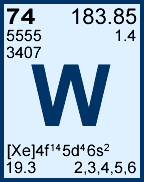
74
W
Tungsten
183.85
+6, +5, +4, +3, +2, 0, -1, -2, -4
Tungsten
Group 6, Period 6
183.85
(6), (7), (8), (9)
(green are observed less frequently)
WOF5-2 (chem. form as received)
+6, +5, +4, +3, +2, 0, -1, -2, -4
Storage & Handling: Keep tightly sealed when not in use. Store and use at 20 ± 4°C. Do not pipet from container. Do not return portions removed for pipetting to container.
Chemical Compatibility: W is very readily hydrolyzed requiring 0.1 to 1% HF for stable acidic solutions. The [WOF5]-2 is soluble in % levels of HCl and HNO3, provided it is in the [WOF5]-2 form. Stable at ppm levels with some metals provided it is fluorinated. Do not mix with Alkaline or Rare Earths. W is best to be mixed only with other fluorinated metals (Ti, Zr, Hf, Nb, Ta, Mo, Si, Sn, Ge). Look for yellow WO3precipitate if mixed with other transitions at higher levels indicating instability. The yellow WO3 will form over a period of weeks even in trace HF, therefore HF levels of W multi-element blends should be ~ 1%.
Stability: 2-100 ppb levels stable (alone or mixed with all other metals that are at comparable levels) as the [WOF5]-2 for months in 1% HNO3 / LDPE container. 1-10,000 ppm single element solutions as the [WOF5]-2 chemically stable for years in 1% HF in a LDPE container.
W Containing Samples (Preparation & Solution): Metal (soluble in HF / HNO3); Oxide (soluble in HF or NH4OH); Organic Matrices (dry ash at 450 0C in Pt0 and dissolve oxide with HF).
Atomic Spectroscopic Information:(red text indicates severe at ~ concs.)
| Technique / Line | Estimated D.L.* | Order | Type | Interferences |
| ICP-OES 207.911 nm | 0.03/.001 µg/mL | 1 | ion | Ru, In |
| ICP-OES 224.875 nm | 0.05/.005 µg/mL | 1 | ion | Co, Rh, Ag |
| ICP-OES 209.475 nm | 0.05/.008 µg/mL | 1 | ion | Mo |
| ICP-MS 182 amu | 5 ppt | n/a | M+ | 166Er16O |
| *ICP-OES D.L.'s are given as radial / axial view | ||||
75
Re
Rhenium
186.207
+7, +6, +5, +4, +3, +2, +1, 0, -1, -3
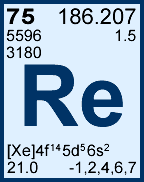
Rhenium
Group 8, Period 6
186.207
(4), (6,) (7), (8), (9)
(green are observed less frequently)
ReO41-
+7, +6, +5, +4, +3, +2, +1, 0, -1, -3
Storage & Handling: Keep tightly sealed when not in use. Store and use at 20 ± 4°C. Do not pipet from container. Do not return portions removed for pipetting to container.
Chemical Compatibility: Stable in HCl, HNO3, H2SO4, HF, and H3PO4. Stable with most metals and inorganic anions in acidic media. Mixing higher levels of ReO41- with Ag+, Hg22+, K+, NH4+, Cs+, Rb+, or Tl+ will give the corresponding salt (solubilities are 1-12 g/L).
Stability: 2-100 ppb levels stable for months in 1% HNO3 / LDPE container. 1-10,000 ppm solutions chemically stable for years in 1-5% HNO3 / LDPE container.
Re Containing Samples (Preparation & Solution): Metal (soluble in HNO3); Oxides / Ores (fuse in Pt0 with Na2CO3). Organic Matrix (all modes of acid attack invite the danger of loss of some volatile perrhenic acid. The use of a reflux condenser should be considered when a wet acid digestion is used such as nitric / perchloric or sulfuric / peroxide digestions. The preferred approach is to ash the sample in Pt0 mixed with Na2CO3 starting the ash at 450°C and then increasing the temperature, if necessary, to 900°C to effect a fusion of accompanying alumino-silicates, etc.).
Atomic Spectroscopic Information:(red text indicates severe at ~ concs.)
| Technique / Line | Estimated D.L.* | Order | Type | Interferences |
| ICP-OES 221.426 nm | 0.006/.0006 µg/mL | 1 | ion | Fe, Os, Mo, Ta |
| ICP-OES 227.525 nm | 0.006/.0006 µg/mL | 1 | ion | Ru, Co, Ca |
| ICP-MS 187 amu | 2 ppt | n/a | M+ | 171Yb16O, 187Os |
| *ICP-OES D.L.'s are given as radial / axial view | ||||
76
Os
Osmium
190.2
+8, +7, +6, +5, +4, +3, +2, +1, 0, -2
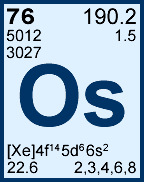
Osmium
Group 8, Period 6
190.2
(4), (5), (6), (8)
(green are observed less frequently)
OsCl62-
+8, +7, +6, +5, +4, +3, +2, +1, 0, -2
Storage & Handling: Keep tightly sealed when not in use. Store and use at 20 ± 4°C. Do not pipet from container. Do not return portions removed for pipetting to container.
Chemical Compatibility: Stable in HCl. Stable with most metals and inorganic anions as the [OsCl6]2- in dilute HCl media. DO NOT EXPOSE TO NITRIC ACID - FORMATION OF THE VERY VOLATILE AND TOXIC OsO4 WILL RESULT. Any oxidizing condition must be avoided.
Stability: 2-100 ppb levels are NOT stable in 1% HNO3 / LDPE container. The stability of HCl solutions at ppb levels has not been determined by our laboratory. 1-10,000 ppm solutions are presumed chemically stable for years in 10% HCl / LDPE container, stability studies have not been performed.
Os Containing Samples (Preparation & Solution): Oxides (fuse with KOH / KNO3 in a Ag0 crucible and dissolve in water being sure to avoid addition of any acid); Ores (see Oxides); Organics (the OsO4 is volatile and acidic oxidizing preparations should be used with caution. The preferred approach is the KOH / KNO3 fusion and dissolution of the fuseate in water. Our laboratory has used APDC to help stabilize Os solutions, but more work is required to validate its effectiveness).
NOTE: The presence of the OsO4 will give false high results due to its enhanced nebulization efficiency (volatility). Only dilutions in HCl should be made. The use of nitric acid should be strictly avoided. Preparations from caustic nitrate fusions should be diluted in water.
Atomic Spectroscopic Information:(red text indicates severe at ~ concs.)
| Technique / Line | Estimated D.L.* | Order | Type | Interferences |
| ICP-OES 225.585 nm | 0.0004 µg/mL | 1 | ion | Fe, Ta, Ge, Ir, Cr |
| ICP-MS 192 amu | 1 ppt | n/a | M+ | 176Yb16O, 176Lu16O, 176Hf16O, 192Pt |
| *ICP-OES D.L.'s are given as radial / axial view | ||||
77
Ir
Iridium
192.22
+6, +5, +4, +3, +2, +1
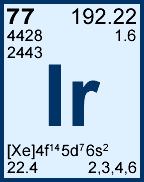
Iridium
Group 9, Period 6
192.22
(6)
IrCl6-2
+6, +5, +4, +3, +2, +1
Storage & Handling: Keep tightly sealed when not in use. Store and use at 20 ± 4°C. Do not pipet from container. Do not return portions removed for pipetting to container.
Chemical Compatibility: Soluble in HCl, HNO3, H2SO4, and HF aqueous matrices. May cause AgCl precipitation when mixed with Ag+. Stable with all other metals.
Stability: 2-100 ppb levels. 2-100 ppb levels stable for months in 1% HNO3 / LDPE container. 1-10,000 ppm solutions chemically stable for years in 10% HCl / LDPE container.
Ir Containing Samples (Preparation & Solution): Metal (elevated temperature with aqua regia or HCl / Cl2{gas} ); Ores (HF / H2SO4 digestion followed by aqua regia digestion); Platinum scrap (aqua regia digestion).
Atomic Spectroscopic Information:(red text indicates severe at ~ concs.)
| Technique / Line | Estimated D.L.* | Order | Type | Interferences |
| ICP-OES 224.268 nm | 0.03 µg/mL | 1 | ion | Cu, Nb, Hf |
| ICP-OES 212.681 nm | 0.03 µg/mL | 1 | ion | Ta, Yb, Au, V |
| ICP-OES 205.222 nm | 0.06 µg/mL | 1 | atom | Fe |
| ICP-MS 191 amu | 2 ppt | n/a | M+ | 175Lu16O |
| *ICP-OES D.L.'s are given as radial / axial view | ||||
78
Pt
Platinum
195.08
+6, +5, +4, +2, 0
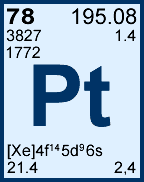
Platinum
Group 10, Period 6
195.08
(6)
Pt(Cl)62-
+6, +5, +4, +2, 0
Storage & Handling: Keep tightly sealed when not in use. Store and use at 20 ± 4°C. Do not pipet from container. Do not return portions removed for pipetting to container.
Chemical Compatibility: Stable in HCl and HNO3, as the chloride complex. Avoid basic media. Stable with most metals and inorganic anions in acidic media.
Stability: 2-10 ppb Pt is stable for 2 months in 1% HNO3 / LDPE container. 100 ppb is stable for 5 months in 1% HNO3 / LDPE container. 1-10,000 ppm solutions chemically stable for years in 10 % HCl / LDPE container.
Pt Containing Samples (Preparation & Solution): Metal (aqua regia); Oxides (soluble in HCl); Ores (dissolve in HCl / HNO3).
Atomic Spectroscopic Information:(red text indicates severe at ~ concs.)
| Technique / Line | Estimated D.L.* | Order | Type | Interferences |
| ICP-OES 214.423 nm | 0.03/.003 µg/mL | 1 | ion | W, As, Ir, Cd |
| ICP-OES 203.646 nm | 0.06/.006 µg/mL | 1 | ion | Co, Hf |
| ICP-MS 195 amu | 5 ppt | n/a | M+ | 179Hf16O |
| *ICP-OES D.L.'s are given as radial / axial view | ||||
79
Au
Gold
196.9665
+7, +5, +3, +1
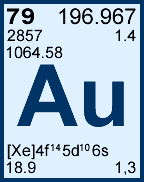
Gold
Group 11, Period 6
196.9665
(6)
Au(Cl)63-
+7, +5, +3, +1
Storage & Handling: Keep tightly sealed when not in use. Store and use at 20 ± 4°C. Do not pipet from container. Do not return portions removed for pipetting to container.
Chemical Compatibility: Stable in HCl, and HNO3, as the chloride complex. Avoid basic media. Stable with most metals and inorganic anions in acidic media.
Stability: 2-100 ppb levels. 2-10 ppb Au is stable for ≤ 1 day maximum in 1% HNO3 / LDPE container. 100 ppb is stable for ≤ 2 days maximum in 1% HNO3 / LDPE container. 1-10,000 ppm solutions chemically stable for years in 10% HCl / LDPE container.
Au Containing Samples (Preparation & Solution): Metal (aqua regia); Oxides (soluble in HCl); Ores (dissolve in HCl / HNO3).
Atomic Spectroscopic Information:(red text indicates severe at ~ concs.)
| Technique / Line | Estimated D.L.* | Order | Type | Interferences |
| ICP-OES 242.795 nm | 0.02/.003 µg/mL | 1 | atom | Mn, Os, Th, Ta, Pt Co, F |
| ICP-OES 267.595 nm | 0.03/.003 µg/mL | 1 | atom | Nb, Ta, U, Cr, Th, Rh, Ru |
| ICP-OES 208.209 nm | 0.04/.01 µg/mL | 1 | ion | Ir, Re |
| ICP-MS 197 amu | 5 ppt | n/a | M+ | 181Ta16O |
| *ICP-OES D.L.'s are given as radial / axial view | ||||
80
Hg
Mercury
200.59
+2, +1
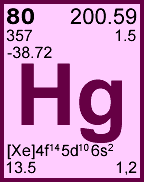
Mercury
Group 12, Period 6
200.59
(4)
Hg(OH)(aq)1+
+2, +1
Storage & Handling: Keep tightly sealed when not in use. Store and use at 20 ± 4°C. Do not pipet from container. Do not return portions removed for pipetting to container.
Chemical Compatibility: Stable in HNO3. Avoid basic media forming insoluble carbonate. The sulfide, basic carbonate, oxalate, phosphate, arsenite, arsenate, and iodide are insoluble in water.
Stability: 2-100 ppb levels - stable in 10% HNO3 packaged in borosilicate glass; NOT stable in 1% HNO3/ LDPE container. 1-100 ppm levels stable in 7% HNO3 packaged in borosilicate glass. 1000-10,000 ppm solutions are chemically stable for years in 5-10% HNO3 / LDPE container.
Hg Containing Samples (Preparation & Solution): Metal (soluble in HNO3); HgO (soluble in HNO3); Ores and Organic based (our documentation has more references to the preparation of Hg containing samples than any other element -- because these preparations are prone to error, we recommend you contact our technical staff at sales@esslab.com or 01702 555577 and we'll provide you with the necessary data for your specific sample type).
Atomic Spectroscopic Information:(red text indicates severe at ~ concs.)
| Technique / Line | Estimated D.L.* | Order | Type | Interferences |
| ICP-OES 184.950 nm | 0.03/.005 µg/mL | 1 | atom | |
| ICP-OES 194.227 nm | 0.03/.005 µg/mL | 1 | ion | V |
| ICP-OES 253.652 nm | 0.1 /.03 µg/mL | 1 | atom | Ta, Co, Th ,Rh , Fe, U |
| ICP-MS 202 amu | 9 ppt | n/a | M+ | 186W16O |
| *ICP-OES D.L.'s are given as radial / axial view | ||||
81
Tl
Thallium
204.383
+3, +1
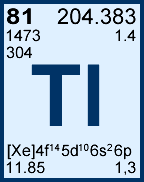
Thallium
Group 13, Period 6
204.383
(6)
Tl(H2O)61+
+3, +1
Storage & Handling: Keep tightly sealed when not in use. Store and use at 20 ± 4°C. Do not pipet from container. Do not return portions removed for pipetting to container.
Chemical Compatibility: Soluble in HCl, HNO3, and H2SO4. Stable with most metals and inorganic anions. The sulfite, thiocyanate, and oxalate are moderately soluble; the phosphate and arsenite are slightly soluble and the sulfide is insoluble.
Stability: 2-100 ppb levels stable for months in 1% HNO3 / LDPE container. 1-10,000 ppm solutions chemically stable for years in 2-5% HNO3 / LDPE container.
Tl Containing Samples (Preparation & Solution): Metal (is best dissolved in HNO3 which forms chiefly the Tl1+ ion); Oxide (the thallous oxide is readily soluble in water. The thallic oxide requires high levels of acid); Ores (carbonate fusion in Pt0 followed by HCl dissolution); Organic Matrices (sulfuric / peroxide digestion or dry ash and dissolution in HCl).
Atomic Spectroscopic Information:(red text indicates severe at ~ concs.)
| Technique / Line | Estimated D.L.* | Order | Type | Interferences |
| ICP-OES 190.864 nm | 0.04/.004 µg/mL | 1 | ion | V, Ti |
| ICP-OES 276.787 nm | 0.1/.01 µg/mL | 1 | atom | Ta, V, Fe, Cr |
| ICP-OES 351.924 nm | 0.2/.02 µg/mL | 1 | atom | Th, Ce, Zr |
| ICP-MS 205 amu | 2 ppt | n/a | M+ | 189Os16O |
| *ICP-OES D.L.'s are given as radial / axial view | ||||
82
Pb
Lead
207.2
+4, +2
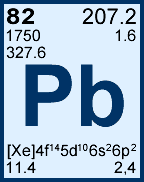
Lead
Group 14, Period 6
207.2
(6)
Pb(H2O)6+2
+4, +2
Storage & Handling: Keep tightly sealed when not in use. Store and use at 20 ± 4°C. Do not pipet from container. Do not return portions removed for pipetting to container.
Chemical Compatibility: Soluble in HCl, HF, and HNO3. Avoid H2SO4. Stable with most metals and inorganic anions forming insoluble carbonate, borate, sulfate, sulfite, sulfide, phosphate, oxalate, chromate, tannate, iodate, and cyanide in neutral aqueous media.
Stability: 2-100 ppb levels stable for months in 1% HNO3 / LDPE container. 1-10,000 ppm solutions chemically stable for years in 2-5% HNO3 / LDPE container.
Pb Containing Samples (Preparation & Solution): Metal (best dissolved in 1:1 H2O / HNO3); Oxides (the many different Pb oxides are soluble in HNO3, with the exception of PbO2 which is soluble in HCl or HF); Ores and Alloys (best attacked using 1:1 H2O / HNO3); Organic Matrices (dry ash and dissolve in dilute HCl. Do not heat when dissolving to avoid precipitation of SiO2).
Atomic Spectroscopic Information:(red text indicates severe at ~ concs.)
| Technique / Line | Estimated D.L.* | Order | Type | Interferences |
| ICP-OES 168.215 nm | 0.03/.003 µg/mL | 1 | ion | Co |
| ICP-OES 220.353 nm | 0.04/.006 µg/mL | 1 | ion | Bi, Nb |
| ICP-OES 217.000 nm | 0.09/.03 µg/mL | 1 | atom | W, Ir, Hf, Sb, Th |
| ICP-MS 208 amu | 5 ppt | n/a | M+ | 192Pt16O, 192Os16O |
| *ICP-OES D.L.'s are given as radial / axial view | ||||
83
Bi
Bismuth
208.9804
+5, +3, +1, -3
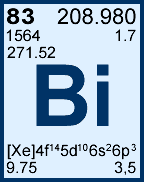
Bismuth
Group 15, Period 6
208.9804
(6)
Bi(O)(H2O)x1+
+5, +3, +1, -3
Storage & Handling: Keep tightly sealed when not in use. Store and use at 20 ± 4°C. Do not pipet from container. Do not return portions removed for pipetting to container.
Chemical Compatibility: Stable in HCl, HNO3, H2SO4, and HF. Avoid basic media forming insoluble hydroxide. Stable with most metals and inorganic anions in acidic media. Many salts that are insoluble in water are soluble in HCl, HNO3 and HF. The major problem with Bi3+ is its tendency to hydrolyze at higher concentrations or in dilute acid. Nitric acid solutions should be 5% to hold the Bi in solution in the 100 to 10000 µg/mL concentration range.
Stability: 2-100 ppb levels stable for months in 1% HNO3 / LDPE container. 1-10,000 ppm solutions chemically stable for years in 5 - 7% HNO3 / LDPE container.
Bi Containing Samples (Preparation & Solution): Metal (soluble in HNO3); Oxides (soluble in HNO3); Alloys (dissolve in conc. 4:1 HCl / HNO3 - heating may be required.); Organic based (dry ash at 450°C and dissolve ash in HNO3 or acid digestion with conc. hot sulfuric acid adding hydrogen peroxide carefullydropwise until clear).
Atomic Spectroscopic Information:(red text indicates severe at ~ concs.)
| Technique / Line | Estimated D.L.* | Order | Type | Interferences |
| ICP-OES 223.061 nm | 0.04/.005 µg/mL | 1 | atom | Th, Ir, Ti Cu |
| ICP-OES 306.772 nm | 0.08/.01 µg/mL | 1 | atom | Th, U, Zr, Hf, Fe |
| ICP-OES 222.825 nm | 0.1/.02 µg/mL | 1 | atom | Cr, Hf, Ce, Os |
| ICP-MS 209 amu | 2 ppt | n/a | M+ | 193Ir16O |
| *ICP-OES D.L.'s are given as radial / axial view | ||||

84
Po
X
Polonium
(209)
+6, +4, +2, -2
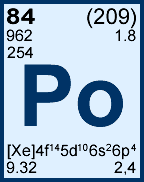
Polonium
(209)
+6, +4, +2, -2
85
At
X
Astatine
(210)
+3, +1, -1
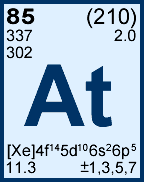
Astatine
(210)
+3, +1, -1
86
Rn
X
Radon
(222)
+2
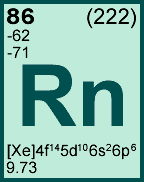
Radon
(222)
+2
7
87
Fr
X
Francium
(223)
+1
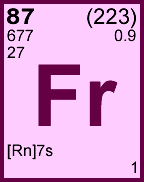
Francium
(223)
+1
88
Ra
X
Radium
226.025
+2
Radium
226.025
+2
104
Rf
X
Rutherfordium
(267)
Rutherfordium
(267)
105
Db
X
Dubnium
(268)
Dubnium
(268)
106
Sg
X
Seaborgium
(269)
Seaborgium
(269)
107
Bh
X
Bohrium
(270)
Bohrium
(270)
108
Hs
X
Hassium
(277)
Hassium
(277)
109
Mt
X
Meitnerium
(278)
Meitnerium
(278)
110
Ds
X
Darmstadtium
(281)
Darmstadtium
(281)
111
Rg
X
Roentgenium
(282)
Roentgenium
(282)
112
Cn
X
Copernicium
(285)
Copernicium
(285)
113
Nh
X
Nihonium
(286)
Nihonium
(286)
114
Fl
X
Flerovium
(289)
Flerovium
(289)
115
Mc
X
Moscovium
(290)
Moscovium
(290)
116
Lv
X
Livermorium
(293)
Livermorium
(293)
117
Ts
X
Tennessine
(294)
Tennessine
(294)
118
Og
X
Oganesson
(294)
Oganesson
(294)
Lanthanides
57
La
Lanthanum
138.9055
+3
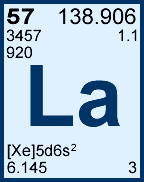
Lanthanum
Group 3, Period 6 (lanthanoid)
138.9055
6 to 9, 10 for some compounds
La(OH)y(H2O)x+3-y
+3
Storage & Handling: Keep tightly sealed when not in use. Store and use at 20 ± 4°C. Do not pipet from container. Do not return portions removed for pipetting to container.
Chemical Compatibility: Soluble in HCl and HNO3. Avoid HF, H3PO4, H2SO4 and neutral to basic media. Stable with most metals and inorganic anions forming an insoluble carbonate, oxide, oxalate, and fluoride and sparingly soluble sulfates (La - Eu exhibit low sulfate solubility). Avoid mixing with elements / solutions containing moderate amounts of fluoride.
Stability: 2-100 ppb levels stable for months in 1% HNO3 / LDPE container. 1-10,000 ppm solutions chemically stable for years in 2-5 % HNO3 / LDPE container.
La Containing Samples (Preparation & Solution): Metal (soluble in acids); Oxide (dissolved by heating in H2O / HNO3); Ores (carbonate fusion in Pt0 followed by HCl dissolution); Organic Matrices (dry ash and dissolve in 1:1 H2O / HCl or HNO3).
Atomic Spectroscopic Information:(red text indicates severe at ~ concs.)
| Technique / Line | Estimated D.L.* | Order | Type | Interferences |
| ICP-OES 333.749 nm | 0.01/.001 µg/mL | 1 | ion | |
| ICP-OES 408.672 nm | 0.01/.001 µg/mL | 1 | ion | Th |
| ICP-OES 412.323 nm | 0.01/.001 µg/mL | 1 | ion | Ce, Th |
| ICP-MS 139 amu | 1 ppt | n/a | M+ | 123Sb16O, 123Te16O |
| *ICP-OES D.L.'s are given as radial / axial view | ||||
58
Ce
Cerium
140.12
+4, +3
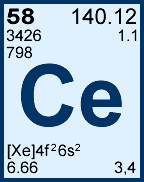
Cerium
Period 6 (lanthanoid)
140.12
6 to 9, 10 for some compounds
Ce(OH)y(H2O)x+4-y
+4, +3
Storage & Handling: Keep tightly sealed when not in use. Store and use at 20 ± 4°C. Do not pipet from container. Do not return portions removed for pipetting to container.
Chemical Compatibility: Soluble in HCl and HNO3. Avoid HF, H3PO4, H2SO4 and neutral to basic media. Stable with most metals and inorganic anions forming an insoluble carbonate, oxide, oxalate, and fluoride and sparingly soluble sulfates (La - Eu exhibit low sulfate solubility). Avoid mixing with elements / solutions containing moderate amounts of fluoride.
Stability: 2-100 ppb levels stable for months in 1% HNO3 / LDPE container. 1-10,000 ppm solutions chemically stable for years in 2-5% HNO3 / LDPE container.
Ce Containing Samples (Preparation & Solution): Metal (soluble in acids); Oxide (dissolved by heating in H2O / HNO3); Ores (carbonate fusion in Pt0 followed by HCl dissolution); Organic Matrices (dry ash and dissolve in 1:1 H2O / HCl or HNO3).
Atomic Spectroscopic Information:(red text indicates severe at ~ concs.)
| Technique / Line | Estimated D.L.* | Order | Type | Interferences |
| ICP-OES 413.765 nm | 0.05/.0058 µg/mL | 1 | ion | Ce** |
| ICP-OES 418.660 nm | 0.05/.003 µg/mL | 1 | ion | Zr |
| ICP-OES 453.975 nm | 0.06/.0063 µg/mL | 1 | ion | |
| ICP-MS 140 amu | 1 ppt | n/a | M+ | 124Sn16O, 124Te16O |
| *ICP-OES D.L.'s are given as radial / axial view **413.747 line may effect Bkg. Corr. | ||||
59
Pr
Praesodymium
140.9077
+4, +3
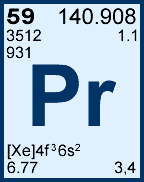
Praesodymium
Period 6 (lanthanoid)
140.9077
6 to 9, 10 for some compounds
Pr(OH)y(H2O)x+3-y
+4, +3
Storage & Handling: Keep tightly sealed when not in use. Store and use at 20 ± 4°C. Do not pipet from container. Do not return portions removed for pipetting to container.
Chemical Compatibility: Soluble in HCl and HNO3. Avoid HF, H3PO4, H2SO4, and neutral to basic media. Stable with most metals and inorganic anions forming an insoluble carbonate, oxide, oxalate, and fluoride and sparingly soluble sulfates (La - Eu exhibit low sulfate solubility). Avoid mixing with elements / solutions containing moderate amounts of fluoride.
Stability: 2-100 ppb levels stable for months in 1% HNO3 / LDPE container. 1-10,000 ppm solutions chemically stable for years in 2-5% HNO3 / LDPE container.
Pr Containing Samples (Preparation & Solution): Metal (soluble in acids); Oxide (dissolved by heating in H2O / HNO3); Ores (carbonate fusion in Pt0 followed by HCl dissolution); Organic Matrices (dry ash and dissolve in 1:1 H2O / HCl or HNO3).
Atomic Spectroscopic Information:(red text indicates severe at ~ concs.)
| Technique / Line | Estimated D.L.* | Order | Type | Interferences |
| ICP-OES 414.311 nm | 0.04/.004 µg/mL | 1 | ion | Ce |
| ICP-OES 417.939 nm | 0.04/.004 µg/mL | 1 | ion | Cr, Ce |
| ICP-OES 422.535 nm | 0.04/.004 µg/mL | 1 | ion | V, U |
| ICP-MS 141 amu | 0.3 ppt | n/a | M+ | 125Te16O |
| *ICP-OES D.L.'s are given as radial / axial view | ||||
60
Nd
Neodymium
144.24
+4, +3, +2
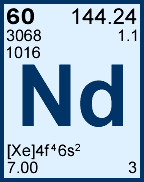
Neodymium
Period 6 (lanthanoid)
144.24
6 to 9, 10 for some compounds
Nd(OH)y(H2O)x+3-y
+4, +3, +2
Storage & Handling: Keep tightly sealed when not in use. Store and use at 20 ± 4°C. Do not pipet from container. Do not return portions removed for pipetting to container.
Chemical Compatibility: Soluble in HCl and HNO3. Avoid HF, H3PO4, H2SO4 and neutral to basic media. Stable with most metals and inorganic anions forming an insoluble carbonate, oxide, oxalate, and fluoride and sparingly soluble sulfates (La - Eu exhibit low sulfate solubility). Avoid mixing with elements / solutions containing moderate amounts of fluoride.
Stability: 2-100 ppb levels stable for months in 1% HNO3 / LDPE container. 1-10,000 ppm solutions chemically stable for years in 2-5% HNO3 / LDPE container.
Nd Containing Samples (Preparation & Solution): Metal (soluble in acids); Oxide (dissolved by heating in H2O / HNO3); Ores (carbonate fusion in Pt0 followed by HCl dissolution); Organic Matrices (dry ash and dissolve in 1:1 H2O / HCl or HNO3).
Atomic Spectroscopic Information:(red text indicates severe at ~ concs.)
| Technique / Line | Estimated D.L.* | Order | Type | Interferences |
| ICP-OES 401.225 nm | 0.05/.002 µg/mL | 1 | ion | Ti, Cr |
| ICP-OES 430.358 nm | 0.075/.0014 µg/mL | 1 | ion | |
| ICP-OES 406.109 nm | 0.1/.002 µg/mL | 1 | ion | Ce |
| ICP-MS 146 amu | 2 ppt | n/a | M+ | 130Te16O |
| *ICP-OES D.L.'s are given as radial / axial view | ||||
61
Pm
X
Promethium
(145)
+3
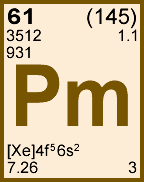
Promethium
(145)
+3
62
Sm
Samarium
150.36
+3, +2
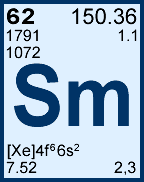
Samarium
Period 6 (lanthanoid)
150.36
6 to 9, 10 for some compounds
Sm(OH)y(H2O)x+3-y
+3, +2
Storage & Handling: Keep tightly sealed when not in use. Store and use at 20 ± 4°C. Do not pipet from container. Do not return portions removed for pipetting to container.
Chemical Compatibility: Soluble in HCl, and HNO3. Avoid HF, H3PO4, H2SO4, and neutral to basic media. Stable with most metals and inorganic anions forming an insoluble carbonate, oxide, oxalate, and fluoride and sparingly soluble sulfates (La - Eu exhibit low sulfate solubility). Avoid mixing with elements / solutions containing moderate amounts of fluoride.
Stability: 2-100 ppb levels stable for months in 1% HNO3 / LDPE container. 1-10,000 ppm solutions chemically stable for years in 2-5% HNO3 / LDPE container.
Sm Containing Samples (Preparation & Solution): Metal (soluble in acids); Oxide (dissolved by heating in H2O / HNO3); Ores (carbonate fusion in Pt0 followed by HCl dissolution); Organic Matrices (dry ash and dissolve in 1:1 H2O / HCl or HNO3).
Atomic Spectroscopic Information:(red text indicates severe at ~ concs.)
| Technique / Line | Estimated D.L.* | Order | Type | Interferences |
| ICP-OES 359.260 nm | 0.05/.002 µg/mL | 1 | ion | W, Th |
| ICP-OES 442.434 nm | 0.075/.0014 µg/mL | 1 | ion | Ce, Ca |
| ICP-OES 428.079 nm | 0.1/.002 µg/mL | 1 | ion | Ce, Cr |
| ICP-MS 152 amu | 2 ppt | n/a | M+ | 136Ce16O, 136Ba16O, 152Gd |
| *ICP-OES D.L.'s are given as radial / axial view | ||||
63
Eu
Europium
151.96
+3, +2
Europium
Period 6 (lanthanoid)
151.96
6 to 9, 10 for some compounds
Eu(OH)y(H2O)x+3-y
+3, +2
Storage & Handling: Keep tightly sealed when not in use. Store and use at 20 ± 4°C. Do not pipet from container. Do not return portions removed for pipetting to container.
Chemical Compatibility: Soluble in HCl and HNO3. Avoid HF, H3PO4, H2SO4, and neutral to basic media. Stable with most metals and inorganic anions forming an insoluble carbonate, oxide, oxalate, and fluoride and sparingly soluble sulfates (La - Eu exhibit low sulfate solubility). Avoid mixing with elements / solutions containing moderate amounts of fluoride.
Stability: 2-100 ppb levels stable for months in 1% HNO3 / LDPE container. 1-10,000 ppm solutions chemically stable for years in 2-5% HNO3 / LDPE container.
Eu Containing Samples (Preparation & Solution): Metal (soluble in acids); Oxide (dissolved by heating in H2O / HNO3); Ores (carbonate fusion in Pt0 followed by HCl dissolution); Organic Matrices (dry ash and dissolve in 1:1 H2O / HCl or HNO3).
Atomic Spectroscopic Information:(red text indicates severe at ~ concs.)
| Technique / Line | Estimated D.L.* | Order | Type | Interferences |
| ICP-OES 381.967 nm | 0.003/.0003 µg/mL | 1 | ion | Cr, V |
| ICP-OES 412.970 nm | 0.004/.0004 µg/mL | 1 | ion | Nb |
| ICP-OES 420.505 nm | 0.004/.0004 µg/mL | 1 | ion | Ce, V |
| ICP-MS 153 amu | 1 ppt | n/a | M+ | 137Ba16O |
| *ICP-OES D.L.'s are given as radial / axial view | ||||
64
Gd
Gadolinium
157.25
+3, +2
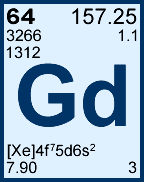
Gadolinium
Period 6 (lanthanoid)
157.25
6 to 9, 10 for some compounds
Gd(OH)x(H2O)y+3-x
+3, +2
Storage & Handling: Keep tightly sealed when not in use. Store and use at 20 ± 4°C. Do not pipet from container. Do not return portions removed for pipetting to container.
Chemical Compatibility: Soluble in HCl, H2SO4, and HNO3. Avoid HF, H3PO4, and neutral to basic media. Stable with most metals and inorganic anions forming an insoluble carbonate, oxide, oxalate, and fluoride. Avoid mixing with elements / solutions containing moderate amounts of fluoride.
Stability: 2-100 ppb levels stable for months in 1% HNO3 / LDPE container. 1-10,000 ppm solutions chemically stable for years in 2-5% HNO3 / LDPE container.
Gd Containing Samples (Preparation & Solution): Metal (soluble in acids); Oxide (dissolved by heating in H2O / HNO3); Ores (carbonate fusion in Pt0 followed by HCl dissolution); Organic Matrices (dry ash and dissolve in 1:1 H2O / HCl or HNO3).
Atomic Spectroscopic Information:(red text indicates severe at ~ concs.)
| Technique / Line | Estimated D.L.* | Order | Type | Interferences |
| ICP-OES 342.247 nm | 0.014/.001 µg/mL | 1 | ion | Th, U |
| ICP-OES 336.223 nm | 0.02/.0002 µg/mL | 1 | ion | Th, Ca |
| ICP-OES 335.047 nm | 0.02/.002 µg/mL | 1 | ion | Ce, Ca |
| ICP-MS 158 amu | 2 ppt | n/a | M+ | 142Ce16O, 142Nd16O, 158Dy |
| *ICP-OES D.L.'s are given as radial / axial view | ||||
65
Tb
Terbium
158.9254
+4, +3
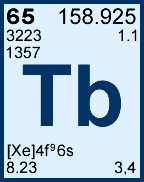
Terbium
Period 6 (lanthanoid)
158.9254
6 to 9, 10 for some compounds
Tb(OH)x(H2O)y+3-x
+4, +3
Storage & Handling: Keep tightly sealed when not in use. Store and use at 20 ± 4°C. Do not pipet from container. Do not return portions removed for pipetting to container.
Chemical Compatibility: Soluble in HCl, H2SO4, and HNO3. Avoid HF, H3PO4, and neutral to basic media. Stable with most metals and inorganic anions forming an insoluble carbonate, oxide, oxalate, and fluoride. Avoid mixing with elements / solutions containing moderate amounts of fluoride.
Stability: 2-100 ppb levels stable for months in 1% HNO3 / LDPE container. 1-10,000 ppm solutions chemically stable for years in 2-5% HNO3 / LDPE container.
Tb Containing Samples (Preparation & Solution): Metal (soluble in acids); Oxide (dissolved by heating in H2O / HNO3); Ores (carbonate fusion in Pt0 followed by HCl dissolution); Organic Matrices (dry ash and dissolve in 1:1 H2O / HCl or HNO3).
Atomic Spectroscopic Information:(red text indicates severe at ~ concs.)
| Technique / Line | Estimated D.L.* | Order | Type | Interferences |
| ICP-OES 350.917 nm | 0.02/.002 µg/mL | 1 | ion | V, Th, Ce, Zr |
| ICP-OES 367.635 nm | 0.06/.006 µg/mL | 1 | ion | Ta, Ce, Co, U |
| ICP-MS 159 amu | 1 ppt | n/a | M+ | 143Nd16O, 127I16O2 |
| *ICP-OES D.L.'s are given as radial / axial view | ||||
66
Dy
Dysprosium
162.50
+4, +3, +2
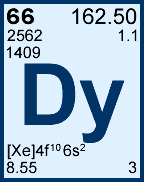
Dysprosium
Period 6 (lanthanoid)
162.50
6 to 9, 10 for some compounds
Dy(OH)x(H2O)y+3-x
+4, +3, +2
Storage & Handling: Keep tightly sealed when not in use. Store and use at 20 ± 4°C. Do not pipet from container. Do not return portions removed for pipetting to container.
Chemical Compatibility: Soluble in HCl, H2SO4 and HNO3. Avoid HF, H3PO4 and neutral to basic media. Stable with most metals and inorganic anions forming an insoluble carbonate, oxide, oxalate, and fluoride. Avoid mixing with elements / solutions containing moderate amounts of fluoride.
Stability: 2-100 ppb levels stable for months in 1% HNO3 / LDPE container. 1-10,000 ppm solutions chemically stable for years in 2-5% HNO3 / LDPE container.
Dy Containing Samples (Preparation & Solution): Metal (soluble in acids); Oxide (dissolved by heating in H2O/ HNO3); Ores (carbonate fusion in Pt0 followed by HCl dissolution); Organic Matrices (dry ash and dissolve in 1:1 H2O / HCl or HNO3).
Atomic Spectroscopic Information:(red text indicates severe at ~ concs.)
| Technique / Line | Estimated D.L.* | Order | Type | Interferences |
| ICP-OES 340.780 nm | 0.007/.0007 µg/mL | 1 | ion | Hf, Th, U, Zr |
| ICP-OES 353.170 nm | 0.013/.001 µg/mL | 1 | ion | Ce, Th |
| ICP-MS 163 amu | 3 ppt | n/a | M+ | 147Sm16O |
| *ICP-OES D.L.'s are given as radial / axial view | ||||
67
Ho
Holmium
164.9304
+3
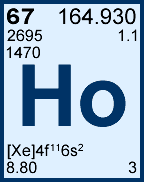
Holmium
Period 6 (lanthanoid)
164.9304
6 to 9, 10 for some compounds
Ho(OH)x(H2O)y+3-x
+3
Storage & Handling: Keep tightly sealed when not in use. Store and use at 20 ± 4°C. Do not pipet from container. Do not return portions removed for pipetting to container.
Chemical Compatibility: Soluble in HCl, H2SO4, and HNO3. Avoid HF, H3PO4, and neutral to basic media. Stable with most metals and inorganic anions forming an insoluble carbonate, oxide, oxalate, and fluoride. Avoid mixing with elements / solutions containing moderate amounts of fluoride.
Stability: 2-100 ppb levels stable for months in 1% HNO3 / LDPE container. 1-10,000 ppm solutions chemically stable for years in 2-5% HNO3 / LDPE container.
Ho Containing Samples (Preparation & Solution): Metal (soluble in acids); Oxide (dissolved by heating in H2O / HNO3); Ores (carbonate fusion in Pt0 followed by HCl dissolution); Organic Matrices (dry ash and dissolve in 1:1 H2O / HCl or HNO3).
Atomic Spectroscopic Information:(red text indicates severe at ~ concs.)
| Technique / Line | Estimated D.L.* | Order | Type | Interferences |
| ICP-OES 345.600 nm | 0.006/.0001 µg/mL | 1 | ion | U, Ti |
| ICP-OES 339.898 nm | 0.02/.002 µg/mL | 1 | ion | Ce, Re |
| ICP-MS 165 amu | 1 ppt | n/a | M+ | 149Sm16O |
| *ICP-OES D.L.'s are given as radial / axial view | ||||
68
Er
Erbium
167.26
+3
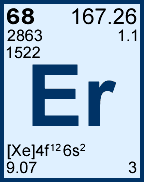
Erbium
Period 6 (lanthanoid)
167.26
6 to 9, 10 for some compounds
Er(OH)x(H2O)y+3-x
+3
Storage & Handling: Keep tightly sealed when not in use. Store and use at 20 ± 4°C. Do not pipet from container. Do not return portions removed for pipetting to container.
Chemical Compatibility: Soluble in HCl, H2SO4, and HNO3. Avoid HF, H3PO4, and neutral to basic media. Stable with most metals and inorganic anions forming an insoluble carbonate, oxide, oxalate, and fluoride. Avoid mixing with elements / solutions containing moderate amounts of fluoride.
Stability: 2-100 ppb levels stable for months in 1% HNO3 / LDPE container. 1-10,000 ppm solutions chemically stable for years in 2-5% HNO3 / LDPE container.
Er Containing Samples (Preparation & Solution): Metal (soluble in acids); Oxide (dissolved by heating in H2O/ HNO3); Ores (carbonate fusion in Pt0 followed by HCl dissolution); Organic Matrices (dry ash and dissolve in 1:1 H2O / HCl or HNO3).
Atomic Spectroscopic Information:(red text indicates severe at ~ concs.)
| Technique / Line | Estimated D.L.* | Order | Type | Interferences |
| ICP-OES 337.271 nm | 0.01/.001 µg/mL | 1 | ion | Th, Ti |
| ICP-OES 349.910 nm | 0.02/.002 µg/mL | 1 | ion | Ru, Th, U |
| ICP-MS 166 amu | 1 ppt | n/a | M+ | 150Sm16O, 150Nd16O |
| *ICP-OES D.L.'s are given as radial / axial view | ||||
69
Tm
Thulium
168.9342
+3, +2
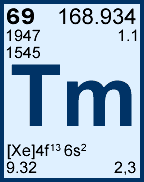
Thulium
Period 6 (lanthanoid)
168.9342
6 to 9, 10 for some compounds
Tm(OH)x(H2O)y+3-x
+3, +2
Storage & Handling: Keep tightly sealed when not in use. Store and use at 20 ± 4°C. Do not pipet from container. Do not return portions removed for pipetting to container.
Chemical Compatibility: Soluble in HCl, H2SO4 and HNO3. Avoid HF, H3PO4, and neutral to basic media. Stable with most metals and inorganic anions forming an insoluble carbonate, oxide, oxalate, and fluoride. Avoid mixing with elements / solutions containing moderate amounts of fluoride.
Stability: 2-100 ppb levels stable for months in 1% HNO3 / LDPE container. 1-10,000 ppm solutions chemically stable for years in 2-5% HNO3 / LDPE container.
Tm Containing Samples (Preparation & Solution): Metal (soluble in acids); Oxide (dissolved by heating in H2O / HNO3); Ores (carbonate fusion in Pt0 followed by HCl dissolution); Organic Matrices (dry ash and dissolve in 1:1 H2O / HCl or HNO3).
Atomic Spectroscopic Information:(red text indicates severe at ~ concs.)
| Technique / Line | Estimated D.L.* | Order | Type | Interferences |
| ICP-OES 313.126 nm | 0.005/.003 µg/mL | 1 | ion | U, Th, Be |
| ICP-OES 346.220 nm | 0.008/.006 µg/mL | 1 | ion | Rh, U |
| ICP-MS 169 amu | 1 ppt | n/a | M+ | 153Eu16O |
| *ICP-OES D.L.'s are given as radial / axial view | ||||
70
Yb
Ytterbium
173.054
+3
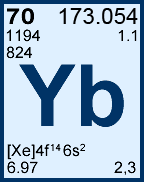
Ytterbium
Period 6 (lanthanoid)
173.054
6 to 9, 10 for some compounds
Yb(OH)x(H2O)y+3-x
+3
Storage & Handling: Keep tightly sealed when not in use. Store and use at 20 ± 4°C. Do not pipet from container. Do not return portions removed for pipetting to container.
Chemical Compatibility: Soluble in HCl, H2SO4, and HNO3. Avoid HF, H3PO4, and neutral to basic media. Stable with most metals and inorganic anions forming an insoluble carbonate, oxide, oxalate, and fluoride. Avoid mixing with elements / solutions containing moderate amounts of fluoride.
Stability: 2-100 ppb levels stable for months in 1% HNO3 / LDPE container. 1-10,000 ppm solutions chemically stable for years in 2-5% HNO3 / LDPE container.
Yb Containing Samples (Preparation & Solution): Metal (soluble in acids); Oxide (dissolved by heating in H2O / HNO3); Ores (carbonate fusion in Pt0 followed by HCl dissolution); Organic Matrices (dry ash and dissolve in 1:1 H2O / HCl or HNO3).
Atomic Spectroscopic Information:(red text indicates severe at ~ concs.)
| Technique / Line | Estimated D.L.* | Order | Type | Interferences |
| ICP-OES 328.937 nm | 0.002/.0003 µg/mL | 1 | ion | U, Ce, V |
| ICP-OES 369.419 nm | 0.003/.0006 µg/mL | 1 | ion | Fe |
| ICP-MS 174 amu | 2 ppt | n/a | M+ | 158Gd16O, 158Dy16O, 174Hf |
| *ICP-OES D.L.'s are given as radial / axial view | ||||
71
Lu
Lutetium
174.9668
+3
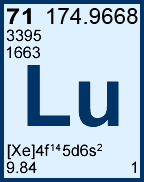
Lutetium
Group 13, Period 5
174.9668
(6)
Lu(OH)x(H2O)y+3-x
+3
Storage & Handling: Keep tightly sealed when not in use. Store and use at 20 ± 4°C. Do not pipet from container. Do not return portions removed for pipetting to container.
Chemical Compatibility: Soluble in HCl, H2SO4, and HNO3. Avoid HF, H3PO4, and neutral to basic media. Stable with most metals and inorganic anions forming an insoluble carbonate, oxide, oxalate, and fluoride. Avoid mixing with elements / solutions containing moderate amounts of fluoride.
Stability: 2-100 ppb levels stable for months in 1% HNO3 / LDPE container. 1-10,000 ppm solutions chemically stable for years in 2-5% HNO3 / LDPE container.
Lu Containing Samples (Preparation & Solution): Metal (soluble in acids); Oxide (dissolved by heating in H2O / HNO3); Ores (carbonate fusion in Pt0 followed by HCl dissolution); Organic Matrices (dry ash and dissolve in 1:1 H2O / HCl or HNO3).
Atomic Spectroscopic Information:(red text indicates severe at ~ concs.)
| Technique / Line | Estimated D.L.* | Order | Type | Interferences |
| ICP-OES 261.542 nm | 0.001/.0003 µg/mL | 1 | ion | Th, Mo, V, W |
| ICP-OES 291.139 nm | 0.006/.0006 µg/mL | 1 | ion | Cr, U |
| ICP-MS 175 amu | 1 ppt | n/a | M+ | 159Tb16O |
| *ICP-OES D.L.'s are given as radial / axial view | ||||
Actinides
89
Ac
X
Actinium
227.028
+3
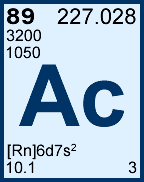
Actinium
227.028
+3
90
Th
Thorium
232.0381
+4, +3, +2
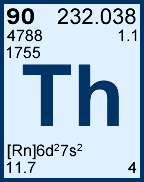
Thorium
Period 7 (actinoid)
232.0381
(8)
Th(OH)3+ and Th(OH)22+
+4, +3, +2
Storage & Handling: Keep tightly sealed when not in use. Store and use at 20 ± 4°C. Do not pipet from container. Do not return portions removed for pipetting to container.
Chemical Compatibility: Soluble in HCl and HNO3. Avoid H3PO4, H2SO4, and HF, although solubilities may not be a problem depending upon pH and matrix (i.e. - ThF4 is soluble in acids). Avoid neutral to basic media. Th4+ is stable with most metals and inorganic anions forming an insoluble carbonate, oxide, fluoride, oxalate, sulfate, and phosphate in neutral to slightly acidic media.
Stability: 2-100 ppb levels stable for months in 1% HNO3 / LDPE container. 1-10,000 ppm solutions chemically stable for years in 2-5% HNO3 / LDPE container.
Th Containing Samples (Preparation & Solution): Metal (soluble in aqua regia); Oxide (the heated oxide is not soluble in acids except hot conc. H2SO4); Ores (Na2O2 fusion at 480 ± 20°C for 7 minutes, cool, and treat sintered mass with 50 mL cold water and let stand until disintegrated. The mass is transferred to a beaker and acidified with HCl, with 25 mL excess HCl added. Any residue is collected on a Whatman No. 42 filter, dried and ignited to 1000°C in Pt0 crucible and ash treated with H2SO4 / HF and fumed. If residue remains, then treat it by peroxide fusion as described above).
Atomic Spectroscopic Information:(red text indicates severe at ~ concs.)
| Technique / Line | Estimated D.L.* | Order | Type | Interferences |
| ICP-OES 283.730 nm | 0.07/.007 µg/mL | 1 | ion | U, Zr |
| ICP-OES 283.231 nm | 0.07/.007 µg/mL | 1 | ion | U, Mo, Ti, Fe, Cr |
| ICP-OES 274.716 nm | 0.08/.008 µg/mL | 1 | ion | Ti, Ta, Fe, V |
| ICP-MS 232 amu | 1 ppt | n/a | M+ | |
| *ICP-OES D.L.'s are given as radial / axial view | ||||
91
Pa
X
Protactinium
231.036
+5, +4, +3
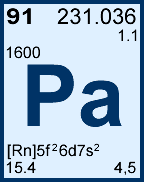
Protactinium
231.036
+5, +4, +3
92
U
Uranium
238.0289
+6, +5, +4, +3
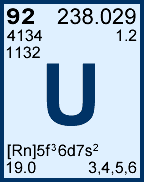
Uranium
Period 7 (actinoid)
238.0289
(8)
UO22+ (uranyl)
+6, +5, +4, +3
Storage & Handling: Keep tightly sealed when not in use. Store and use at 20 ± 4°C. Do not pipet from container. Do not return portions removed for pipetting to container.
Chemical Compatibility: Soluble in HCl and HNO3. Avoid H3PO4. H2SO4 and HF matrices should not be a problem depending upon [U]. Although the UO22+ ion is distinctly basic, any U+4 will ppt. in basic media. UO22+salts are generally soluble in water and UO22+ is stable with most metals and inorganic anions. The uranyl phosphate is insoluble in water. UF4 and UF6 are water soluble.
Stability: 2-100 ppb levels stable for months in 1% HNO3 / LDPE container. 1-10,000 ppm solutions chemically stable for years in 2-5% HNO3 / LDPE container.
U Containing Samples (Preparation & Solution): Metal (dissolves rapidly in HCl and HNO3); Oxide (soluble in HNO3); Ores (digest for 1-2 hours with 1 gram of ore to 30 mL 1:1 HNO3. Silica insolubles are removed by filtration after bringing the sample to fumes with conc. H2SO4).
Atomic Spectroscopic Information:(red text indicates severe at ~ concs.)
| Technique / Line | Estimated D.L.* | Order | Type | Interferences |
| ICP-OES 385.958 nm | 0.3/.01 µg/mL | 1 | ion | Th, Fe |
| ICP-OES 367.007 nm | 0.3/.02 µg/mL | 1 | ion | Th, Ce |
| ICP-OES 263.553 nm | 0.3/.01 µg/mL | 1 | ion | Ce, Ir, Th, Rh, W, Zr, Ta, Ti, V, Hf, Fe, Re, Ru |
| ICP-MS 238 amu | 2 ppt | n/a | M+ | 206Pb16O2 |
| *ICP-OES D.L.'s are given as radial / axial view | ||||
93
Np
X
Neptunium
237.048
+7, +6, +5, +4, +3, +2
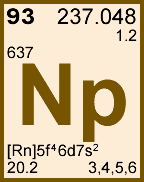
Neptunium
237.048
+7, +6, +5, +4, +3, +2
94
Pu
X
Plutonium
(244)
(+7), +6, +5, +4, +3, +2
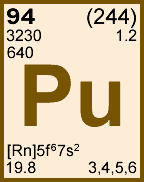
Plutonium
(244)
(+7), +6, +5, +4, +3, +2
95
Am
X
Americium
(243)
+6, +5, +4, +3, +2
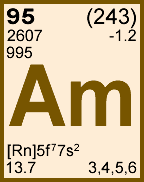
Americium
(243)
+6, +5, +4, +3, +2
96
Cm
X
Curium
(247)
+4, +3, +2
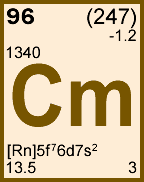
Curium
(247)
+4, +3, +2
97
Bk
X
Berkelium
(247)
+4, +3, +2
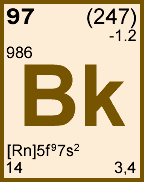
Berkelium
(247)
+4, +3, +2
98
Cf
X
Californium
(251)
+4, +3, +2
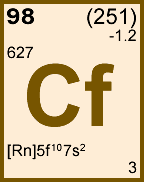
Californium
(251)
+4, +3, +2
99
Es
X
Einsteinium
(254)
(+4), +3, (+2)
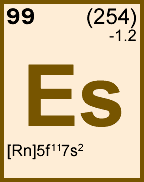
Einsteinium
(254)
(+4), +3, (+2)
100
Fm
X
Fermium
(257)
+3, (+2)
Fermium
(257)
+3, (+2)
101
Md
X
Mendelevium
(258)
+3, +2
Mendelevium
(258)
+3, +2
102
No
X
Nobelium
(259)
+3, +2
Nobelium
(259)
+3, +2
103
Lr
X
Lawrencium
(262)
+3
Lawrencium
(262)
+3
My Wishlist
Wishlist is empty.
Compare
Shopping cart